
That 500 E£ tour price on the flyer isn’t the real cost of your adventure. While a low price looks like a steal, the true hidden costs of tours in Egypt often hide in plain sight through mandatory tips and unlisted entry fees. It’s frustrating to plan a dream vacation only to feel pressured at a “perfume palace” or realize your ticket to the Pyramids just doubled in price. You deserve a journey that’s as magical as it is transparent.
We understand you want to explore the wonders of Luxor and Cairo without worrying about your wallet at every turn. Since the Ministry of Tourism and Antiquities implemented significant price increases for major monuments in mid-2024, budgeting has become more complex. This guide promises to clear the confusion by detailing exactly how much cash you should carry for daily baksheesh and how to identify “commission stops” before they eat your afternoon. We’ll show you how to distinguish a genuine luxury deal from a tourist trap so your 2026 trip remains stress-free and unforgettable.
Understanding Hidden Costs: Why Your “Cheap” Egypt Tour Might Cost More
Planning a trip to see the Wonders of the World is exciting. You find a tour priced at E£600 and think you’ve found a bargain. By the end of the day, you’ve spent E£1,800. This is the reality of hidden costs of tours in Egypt. These expenses aren’t always listed on the booking page. They include site entry fees, mandatory tipping known as baksheesh, and meals that aren’t actually included. Understanding the hidden costs of tours in Egypt before you book ensures your budget remains intact.
The “Sticker Price Illusion” is a common trap for many travelers. Budget operators lure people with low upfront costs. They omit the E£400 entry fee for the Valley of the Kings or the E£200 fee for a professional guide. You pay these “extras” on the spot. It’s vital to distinguish between optional add-ons and mandatory costs. A camel ride might be optional, but the ticket to enter the Giza Plateau is not. Exploring the history of Tourism in Egypt helps you see that these fees are standard, even if your tour operator hides them to look cheaper.
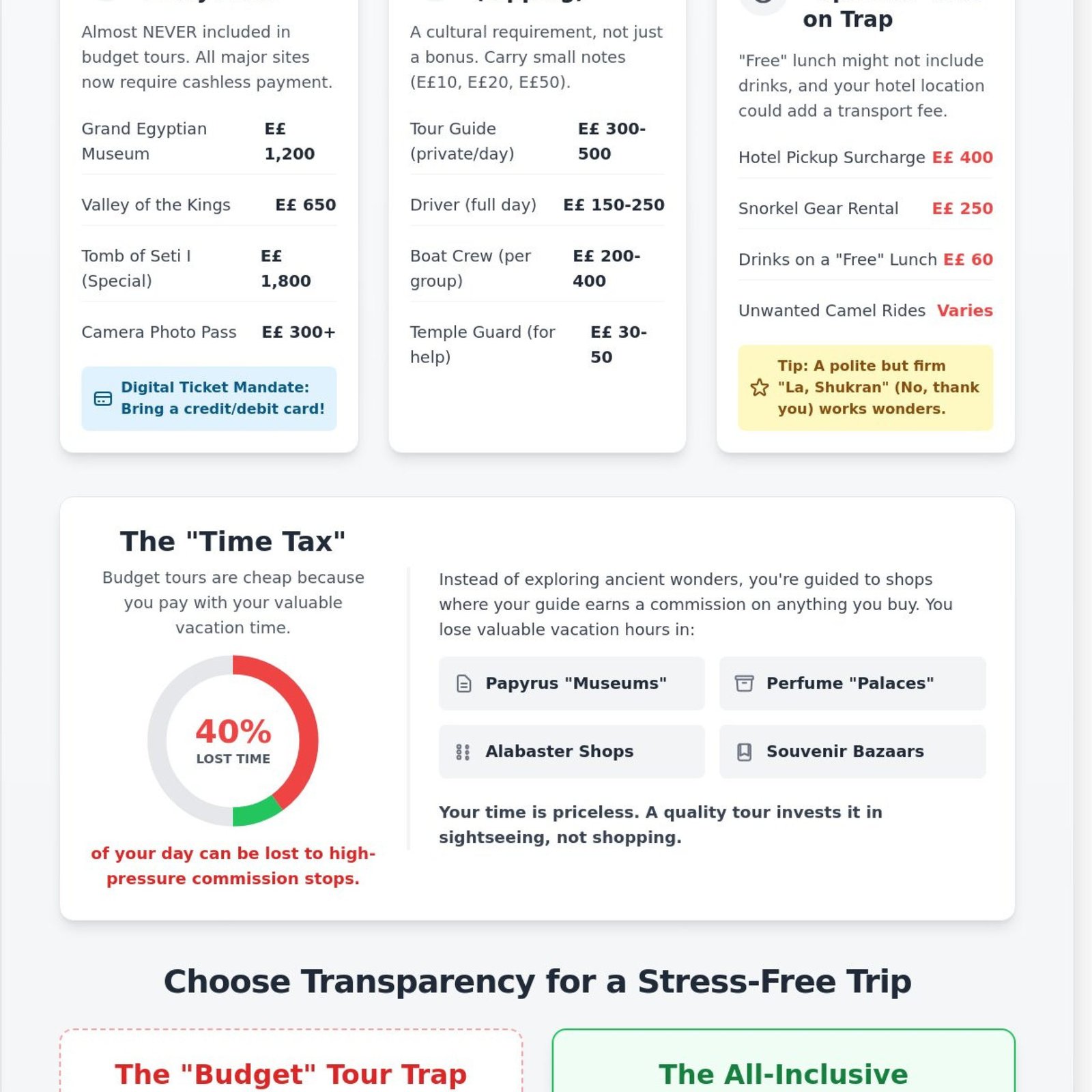
You should also consider the “Time Tax.” Low-cost tours often spend 40% of the day in papyrus, perfume, or alabaster shops. The guide earns a commission on your purchases. This turns your holiday into a shopping trip. You lose valuable hours of sightseeing just to subsidize a cheap ticket price. You don’t want to spend your limited vacation time waiting in a gift shop when you could be exploring a temple.
The Anatomy of a Low-Cost Excursion
Budget operators cut corners to keep prices low. They use older vehicles without working air conditioning. They hire unlicensed guides who lack deep historical knowledge. These guides often rely entirely on the “Commission Model.” They don’t get a fair wage from the operator, so they pressure you to buy souvenirs to make a living. Contrast this with Sola Travel’s best tours. We prioritize your experience by including honest pricing and expert guides who focus on history, not sales. You get a transparent breakdown from the start, so there’s no stress.
Why 2026 is Different: The New Digital Landscape
The Egyptian Ministry of Tourism has modernized the visitor experience for the future. Major sites like the Pyramid of Khufu now require cashless payments. You can’t just hand over cash at the gate anymore. Fluctuating exchange rates make “on-the-spot” EGP payments unpredictable if you’re carrying foreign currency. The Digital Ticket Mandate is a regulation requiring all major archaeological sites to issue electronic tickets purchased via credit or debit cards only. This shift helps eliminate “unofficial” fees but requires travelers to be prepared with the right payment methods before they arrive at the temple gates.
The Big Three: Entry Fees, Tipping, and Transport
Many travelers book a cheap excursion thinking the price is final. They often discover later that the “best price” doesn’t cover the essentials. These hidden costs of tours in Egypt can easily add E£3,000 to a single day’s budget if you aren’t prepared. Understanding these three categories helps you plan a magical journey without financial stress or surprises at the gate.
Monument Entry Fees in 2026
By 2026, entry fees at major monuments have become a significant budget item. A standard ticket for the Grand Egyptian Museum (GEM) now costs approximately E£1,200 for international visitors. If you head to the Valley of the Kings, the standard E£650 ticket covers three tombs. However, iconic “Special Tombs” like Seti I require a separate fee of roughly E£1,800. These fees are almost never included in street-level tour prices. Always check the U.S. State Department travel advice for Egypt to stay updated on entry requirements and potential price hikes. Remember that most sites now allow phone photography for free, but professional cameras still require a paid “Photo Pass” starting at E£300.
Baksheesh: The 2026 Tipping Guide
Tipping, or Baksheesh, isn’t just a reward for good service. It’s a cultural requirement and a central part of the Egyptian service economy. To avoid awkwardness, carry a “tipping kit” of small E£10, E£20, and E£50 notes. Use these guidelines for a smooth trip:
- Drivers: E£150 to E£250 for a full day of service.
- Boat Crews: E£200 to E£400 per group, depending on the boat size.
- Temple Guards: E£30 to E£50 if they show you a restricted area or take a photo.
- Tour Guides: E£300 to E£500 per day for private tours.
The “Optional” Add-on Trap
The most common hidden costs of tours in Egypt involve transport surcharges and equipment rentals. If your hotel is in Makadi Bay or El Gouna but your tour departs from central Hurghada, expect a pickup fee of E£400 per vehicle. On popular Red Sea boat trips, a “free” lunch often excludes bottled water or soda, which can cost E£60 per drink. Snorkeling gear or life jackets might also cost an extra E£250 at the pier if not explicitly listed as included. If you want a transparent experience, choose a provider that lists every inclusion upfront. When faced with unwanted camel rides or extra photos, a polite but firm “La, Shukran” (No, thank you) is the best way to stay on budget.
The “Time Tax”: Commission Stops and Group Logistics
Budget tours often hide their true price behind a “Time Tax.” When you book a tour that seems impossibly cheap, the operator usually makes their profit through commissions. This means your itinerary is designed around retail stops rather than historical sites. You might spend your morning at a “Papyrus Museum” or a “Perfume Palace” instead of the Valley of the Kings. These stops are one of the most common hidden costs of tours in Egypt. They don’t cost you money upfront, but they steal your most valuable resource: your holiday time.
Consider the math of a standard 10-hour tour day. A budget operator might schedule three mandatory shopping stops. Each stop lasts about 60 minutes. When you add the driving time to these specific shops, you lose at least 3 hours of your day. You are essentially paying for a full day of sightseeing but only receiving 70% of the promised experience. If your tour costs E£ 1,200, you are losing E£ 360 in pure time value. Private tours focus on the monuments, giving you those 3 hours back for actual exploration.
The Truth About “Artisan Demonstrations”
Most “demonstrations” are carefully staged sales environments. The staff offers you hibiscus tea and a seat. This hospitality makes it harder to leave without buying something. These stops are strategically placed when you are most tired or hungry, usually right before or after lunch. The U.S. State Department travel advisory highlights the potential for overcharging in tourist areas, and these commission shops are prime examples. Prices for “hand-made” goods in these stores are often 400% higher than in local markets. We recommend looking for tours that explicitly state “No Shopping Stops” to ensure your schedule remains your own.
Group Size vs. Real Value
Large groups create a “Cattle Car” effect that slows everything down. A bus with 40 people moves at the speed of the slowest participant. One person being 10 minutes late for boarding can delay the entire itinerary. This happens multiple times a day. You spend hours waiting for bathroom breaks, headcounts, and ticket distributions. This is the opposite of a bespoke luxury travel experience where the schedule adapts to you.
- Large groups limit your guide’s ability to answer deep questions.
- Waiting for 40 people to board a bus takes 15 to 20 minutes per stop.
- Crowded groups make it harder to hear the history at busy sites like Karnak.
Small-group or private tours offer better value per hour. You move faster, see more, and avoid the hidden costs of tours in Egypt related to lost time. You get the expert’s full attention and the flexibility to stay longer at the sites you love. It is the difference between being a passenger and being an explorer.
Budgeting Like a Pro: Your 2026 Egypt Price Checklist
Planning your dream trip shouldn’t feel like a math test. You want to explore the wonders of the Nile without constantly reaching for your wallet. Many travelers overlook the hidden costs of tours in Egypt, which can quickly turn a budget holiday into an expensive ordeal. Use this 2026 price checklist to stay in control of your spending from day one.
The Pre-Booking Checklist
Verify these items before clicking “Book Now.” First, check if entry tickets are included. If they aren’t, you must add between E£ 2,500 and E£ 5,000 to your budget for a standard itinerary. Second, look at the meal plan. While lunch is often included, drinks almost never are. Expect to pay about E£ 40 for a small water bottle at tourist sites. Finally, watch for “mandatory” shopping stops. These visits to perfume or papyrus shops can waste hours of your sightseeing time.
Currency and Payment Strategy
Egypt’s payment systems have modernized rapidly. The Ministry of Tourism and Antiquities now requires credit or debit cards for entry at major archaeological sites. You cannot pay cash for a ticket at the Pyramids or the Valley of the Kings. Keep your EGP for baksheesh and local markets. In 2026, the Egyptian Pound remains the most efficient way to pay for small daily needs. Use a travel card with 0% foreign transaction fees to save roughly 3% on every swipe.
The high cost of “Independent” travel often surprises people. You might save money on the initial tour price, but you pay a “Haggling Tax” in stress and time. Taxis in Cairo often charge tourists E£ 500 for a trip that should cost E£ 120. You also face safety concerns when navigating unfamiliar areas without a trusted local partner. This constant negotiation drains your energy and your wallet.
Booking with Sola Travel eliminates these headaches. We provide transparent pricing and professional drivers who prioritize your comfort. We create the trips you love by handling the logistics so you can focus on the magic. Our tours often include significant discounts, making luxury travel predictable and affordable. We guarantee the best price and complete transparency on what is included in your journey.
Stop worrying about the small stuff and focus on the adventure. Book your transparently priced Egypt tour today and enjoy a journey without the hidden fees.
The Sola Travel Difference: Transparent Value in 2026
We create the trips you love. Sola Travel balances massive -50% discounts with total transparency, ensuring your Egyptian adventure remains magical and affordable. Many travelers worry that deep discounts lead to unexpected fees, but our model is built on 25 years of experience in navigating Egyptian logistics. We’ve refined our process to eliminate the hidden costs of tours in Egypt that often catch tourists off guard. You get the best of both worlds: incredible savings and a professional, reliable service that respects your budget.
Our “Best Price Guarantee” isn’t just a marketing slogan; it’s a commitment to your final holiday budget. We quote in E£ and stick to it. Because we’ve spent over two decades building relationships with local providers, we secure rates that others simply can’t match. This allows us to pass the savings directly to you without cutting corners on quality or safety. Our Hurghada excursions are a perfect example of this philosophy. We focus on pure adventure, not commission-based shopping stops. Your time is valuable, so we spend it at the reefs and historical sites rather than in high-pressure perfume or papyrus shops.
Why Transparency is the New Luxury
We offer “Pay Now or Pay Later” flexibility to give you complete control over your finances. You don’t have to worry about surprise surcharges upon arrival. Our strict screening process for guides ensures you’re accompanied by experts who prioritize your experience over sales pitches. We handle the complicated details, from local site permits to specific entry requirements, so you don’t have to manage the logistics yourself. It’s a bespoke service that makes luxury travel accessible to everyone.
Start Your Unforgettable Journey
You can book scuba diving in Hurghada or cultural tours across Luxor with absolute confidence. We understand that plans change, which is why we offer a 24-hour free cancellation policy for a full refund. This policy removes the risk of losing your E£ if your schedule shifts. Our goal is to provide a stress-free experience from the moment you click book until you return home. Explore the wonders of the Nile and the Red Sea without the weight of hidden costs of tours in Egypt. Your magical journey starts here, backed by a team that values your trust as much as your adventure.
Master Your Budget for an Unforgettable 2026 Journey
Planning a trip to the Giza Plateau or the temples of Luxor requires more than just a flight booking. You’ve seen how entry fees and daily tipping expectations can quickly shift your E£ budget if you aren’t prepared. Managing these logistics ensures your focus stays on the magic of the Nile rather than unexpected receipts. Navigating the hidden costs of tours in Egypt doesn’t have to be a struggle when you have the right local partner by your side.
We use our 25 years of local expertise to remove the guesswork from your itinerary. You’ll enjoy our Best Price Guarantee on every booking, ensuring you get the most value for every E£ spent. If your plans change, we offer free cancellation up to 24 hours before your tour begins. It’s time to stop worrying about the math and start dreaming about the desert sun. We create the trips you love by focusing on honesty and your happiness.
Book your transparent, stress-free Egypt adventure with Sola Travel today!
Egypt’s ancient wonders are waiting for you, and we’re ready to make your journey truly magical.
Frequently Asked Questions
Do Egypt tour prices usually include entry tickets to the Pyramids?
Most Egypt tour prices don’t include entry tickets to the Pyramids or other major monuments. Tour operators separate these costs so you can choose which specific areas to enter, such as the Great Pyramid interior which costs an extra E£900. By keeping the base price low, we ensure you get the best value while maintaining flexibility for your adventure. Always check your booking confirmation to see exactly what’s covered.
How much should I budget for baksheesh (tipping) per day in 2026?
You should budget between E£400 and E£700 per person per day for baksheesh in 2026. This amount covers small tips for drivers, boat crews, and temple guardians who make your journey magical. For example, a public restroom attendant typically receives E£10 to E£20, while a private tour guide expects around E£300 for a full day of expertise. This cultural practice is a vital part of the local economy.
Are drinks included in tours that offer a “Free Lunch”?
Drinks are almost never included in tours that offer a “Free Lunch” package. While the meal is provided as part of your experience, you’ll pay separately for bottled water, soda, or coffee. Prices at tourist restaurants typically range from E£40 for a small water to E£80 for a soft drink. Understanding these small charges helps you manage the hidden costs of tours in Egypt effectively while enjoying your unforgettable adventure.
Can I pay for my tour entry fees with a credit card at the gate?
You must pay for your tour entry fees with a credit or debit card at all major archaeological sites. The Egyptian Ministry of Tourism and Antiquities transitioned to a mandatory cashless system in 2023 at over 30 sites, including the Valley of the Kings. Cash is no longer accepted at these ticket offices. Ensure your card is active for international transactions to avoid any delays during your exploration of these ancient wonders.
Why do some tours spend so much time at papyrus or perfume shops?
Tours visit papyrus or perfume shops because these stops provide commissions that keep the initial tour price lower for travelers. These venues offer educational demonstrations about ancient Egyptian crafts that many find fascinating. It’s a standard industry practice where the shop pays the tour company a percentage of sales. We focus on reputable shops to ensure you see authentic, high quality products during your journey through Egypt.
What happens if I refuse to go into a shopping stop during my tour?
You can refuse to go into a shopping stop, but it’s most effective to tell your guide at the start of the day. Private tours offer the most flexibility to skip these entirely and focus on the sights. If you’re on a group tour, the schedule often includes these stops for the whole bus. We recommend booking bespoke private tours if you want a journey focused strictly on monuments without any retail interruptions.
Is it cheaper to book tours online or on the street in Hurghada?
Booking tours online is generally cheaper and much safer than buying from vendors on the street in Hurghada. Online platforms offer transparent pricing and significant discounts of up to 50 percent. Street vendors often lack insurance or standardized safety protocols. By booking in advance, you secure your spot and avoid the stress of aggressive haggling. This ensures your journey remains magical and your budget stays protected.
Are there hidden costs for hotel pickups in Marsa Alam or Sharm El Sheikh?
There are often extra charges for hotel pickups if your resort is located outside the central zones of Marsa Alam or Sharm El Sheikh. Hotels in areas like El Quseir or Nabq Bay may incur a transfer fee ranging from E£300 to E£600 per vehicle. These fees cover the additional fuel and time for the long distance travel. We always clarify these hidden costs of tours in Egypt during booking so there are no surprises.



Comment (0)