
What if your bank’s “convenient” exchange rate is actually costing you a luxury dinner overlooking the Pyramids every single day? You probably feel anxious about carrying too much cash through a busy bazaar or getting hit with surprise fees at a Cairo terminal. It is a common worry for the 14.9 million tourists expected to visit the country by the end of 2026. We believe your adventure should be magical, not a math headache. We guarantee that with the right knowledge, you can save enough on fees to fund an extra snorkeling cruise in Hurghada.
We are here to ensure you master currency exchange and using ATMs in Egypt for a stress-free journey. You deserve to spend your budget on unforgettable experiences like sunrise hot air balloons rather than hidden bank charges. This guide provides expert advice on the safest ATM spots, current 2026 tipping standards, and the exact steps to avoid Dynamic Currency Conversion traps. These traps often inflate costs by 5% to 12% per transaction. You will know exactly how to decline them and keep your travel funds secure for the moments that matter.
Understanding the Egyptian Pound (EGP) in 2026
Your Egyptian adventure starts with the local currency. The Egyptian Pound is the official currency of Egypt and its official ISO code is EGP. While you’ll see it written as LE (Livre Égyptienne), locals call it the “guinea” or “gineih.” Getting familiar with these colorful notes is the first step toward a stress free journey through the land of the Pharaohs.
In 2026, the Egyptian economy has moved into a period of relative stability. Following the major fiscal reforms of 2024, the currency now fluctuates within a predictable range. You’ll use currency exchange and using ATMs in Egypt to fund everything from your sunrise hot air balloon ride in Luxor to a simple hibiscus tea at a Cairo cafe. While credit cards are becoming more common in luxury hotels, cash remains the king of the street.
The 2026 Currency Landscape
As of early 2026, the exchange rate has stabilized around 48 to 52 EGP per 1 USD. Similar trends apply to the EUR and GBP, which remain strong against the pound. You should strictly avoid any “Black Market” offers you might encounter on the street. These unofficial channels are illegal and often involve counterfeit notes or scams. Stick to official bank kiosks and authorized exchange offices found in airports and city centers. These official channels guarantee you the best price and complete security for your money.
Recognising Your Money
Egyptian banknotes come in denominations of 5, 10, 20, 50, 100, and 200 EGP. The 10 and 20 pound notes are now primarily polymer, which makes them feel like plastic and much harder to tear. Understanding the Egyptian Pound denominations is vital because the 50 and 200 pound notes share a similar color palette. Always double check the numbers in the corner before handing over cash in a busy market.
- 200 EGP: The highest value note, used for large purchases or tour payments.
- 100 EGP: The most common note for dinner or shopping.
- 10 & 20 EGP: Durable polymer notes perfect for quick transactions.
- 1 EGP: Mostly found as a silver coin, though rare paper versions still circulate.
Small change is your most valuable asset in Egypt. At least 80% of daily interactions, such as tipping (baksheesh), using public restrooms, or buying street food, require small notes. Don’t let your 5 and 10 pound notes go easily. When you’re currency exchange and using ATMs in Egypt, try to break your larger 100 or 200 pound notes at supermarkets or pharmacies to keep a steady supply of small change for the souqs. Always look for the holographic security thread and the watermark of the Great Sphinx when receiving change to ensure your money is authentic.
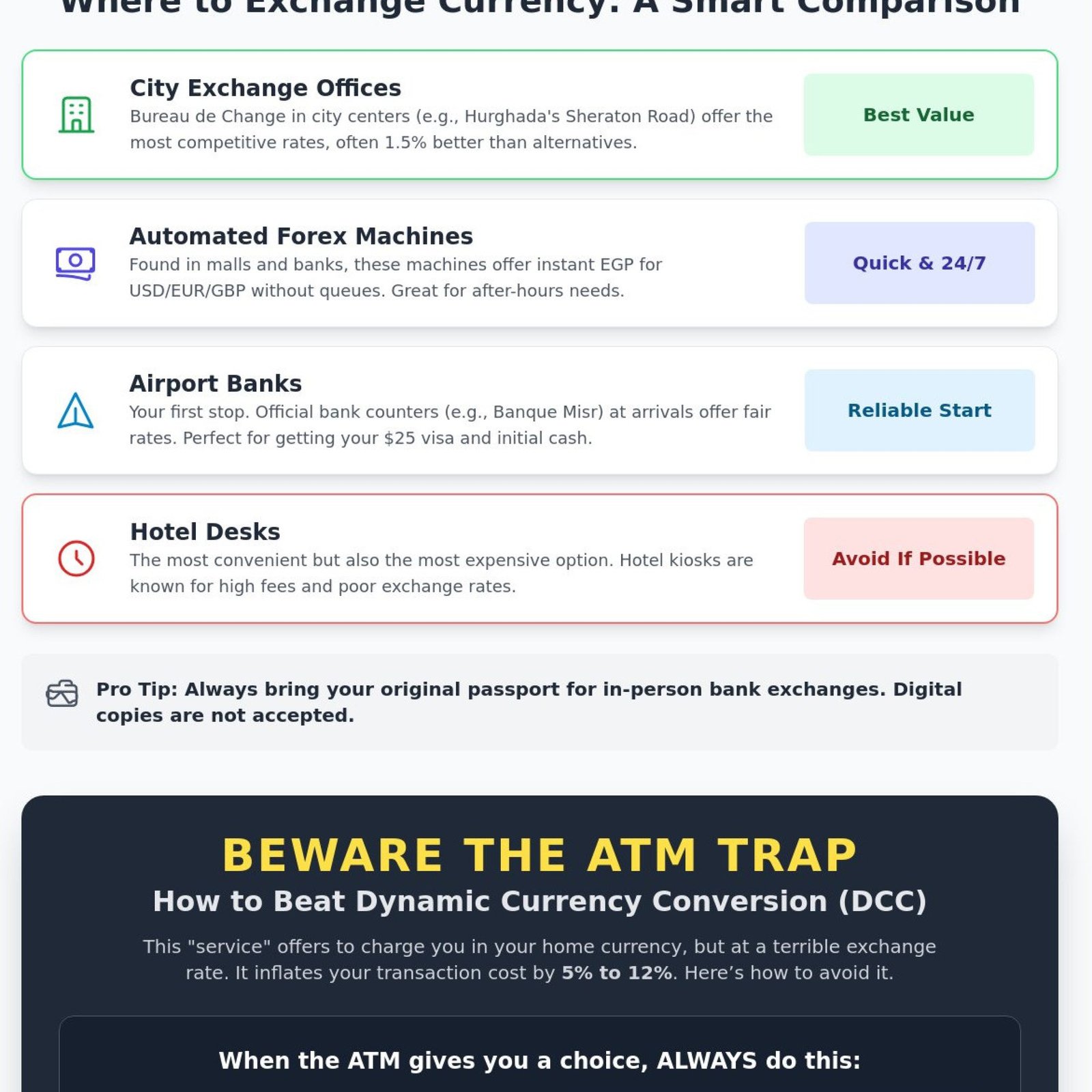
Where to Exchange Currency: Best Rates and Locations
Securing the best rates for currency exchange and using ATMs in Egypt starts the moment you land. Most travelers find their first transaction at the ‘Visa on Arrival’ counter in Cairo or Hurghada. These counters are operated by official banks like Banque Misr. They offer fair market rates that align with national standards. You’ll need $25 USD for your visa, and you can exchange your remaining cash right there. It’s a fast, official way to get your first Egyptian Pounds.
While airport banks are convenient, city centers often provide better value. In Hurghada, exchange offices on Sheraton Road typically offer rates 1.5% better than hotel desks. Hotel kiosks are notorious for high convenience fees. Always check a live rate app like XE or OANDA before you swap your cash. For your safety and to stay informed on cash entry limits, consult the official travel and currency advice before your journey begins.
Airport vs. City Exchange
The bank windows at the airport are your most reliable first stop. They operate 24/7 to meet every international flight. If you’re heading to a resort in Sharm El Sheikh, wait until you reach the city center for larger transactions. Local Bureau de Change offices in Naama Bay often beat resort prices. Don’t let convenience eat your budget. A quick 10-minute walk into town can save you enough for an unforgettable snorkeling cruise with Sola Travel. We guarantee you the best price on your adventures, so don’t waste it on bad exchange rates.
Banks and Official Kiosks
Major institutions like CIB, HSBC Egypt, and Banque Misr are your best bet for security. Most branches open from 8:30 AM to 3:00 PM, Sunday through Thursday. By 2026, automated Forex exchange machines have become a standard feature in most Egyptian cities. These machines allow you to insert USD, EUR, or GBP and receive EGP instantly without human interaction. They work 24/7 and are found in major malls and bank foyers.
- Passport Required: You must present your original passport for any in-person bank exchange. Digital copies are rarely accepted in 2026.
- Digital Shift: Multi-currency cards like Wise and Revolut are widely accepted in urban hubs and luxury resorts.
- Forex Machines: Use the green ‘Exchange’ machines for private, quick transactions without the bank queues.
Reputable exchange offices in Red Sea resorts are easy to identify. Look for signs from established brands like Western Union or Thomas Cook. These offices are strictly regulated by the Central Bank of Egypt. Always count your money twice before leaving the window. Mastering currency exchange and using ATMs in Egypt ensures you get the best value for every pound spent on your magical journey.
Using ATMs in Egypt: Safety, Fees, and Limits
Finding cash for your Red Sea adventure is easier than ever. In 2026, over 98% of tourist zones in Hurghada, Sharm El Sheikh, and Marsa Alam feature 24-hour ATM access. You’ll find machines tucked into hotel lobbies, modern shopping malls, and along every main promenade. Mastering currency exchange and using ATMs in Egypt ensures you always have enough Egyptian Pounds (EGP) for local markets, small cafes, and tipping your guides.
Most major Egyptian bank networks set daily withdrawal limits for international cards between 5,000 EGP and 10,000 EGP in 2026. If you require a larger sum for a bespoke excursion, you may need to perform multiple transactions or visit a bank branch with your passport. Always notify your home bank of your travel dates to prevent them from freezing your card during your first transaction in Cairo or Hurghada.
The “Dynamic Currency Conversion” (DCC) trap is the most common pitfall for travelers. When the ATM screen asks if you want to be charged in your home currency like USD or EUR, always select “No” or “Decline Conversion.” Choosing the local currency option allows your home bank to handle the exchange rate. This simple choice saves you from predatory markups that frequently reach 7% to 10% above the mid-market rate.
Safety remains a top priority for every traveler. Stick to ATMs located inside bank foyers or well-lit shopping centers. Avoid using isolated machines on quiet streets late at night. For the latest official guidance on security and financial regulations, check the U.S. Department of State Travel Advisory for Egypt. It provides essential context for navigating the country safely while managing your travel funds.
ATM Fees and Charges
Expect two separate costs when you withdraw cash in Egypt. Your home bank likely charges a foreign transaction fee, while the Egyptian bank adds its own service cost. Most Egyptian ATMs charge a flat fee per transaction in 2026, usually ranging from 60 to 120 EGP. You’ll get the best value by making fewer, larger withdrawals. Always choose “Charge in Local Currency” to avoid the high markups associated with instant conversion offers on the screen.
Finding Reliable ATMs
Stick to reputable bank networks to ensure your international card works every time. CIB (Commercial International Bank), QNB, and the National Bank of Egypt are the most reliable options for foreign travelers. These banks offer English language menus and high uptime. If an ATM swallows your card, which is a rare occurrence, stay at the machine and call the bank’s emergency number printed on the frame. Using machines attached to open bank branches during business hours makes resolving these rare issues much faster. Use official bank apps to locate machines before heading out on remote desert excursions where cash access is limited.
Cash vs. Card: Spending Wisely from Cairo to Hurghada
By January 2026, Egypt’s financial landscape has transformed. You’ll find that 85% of major hotels and luxury malls in Cairo and Hurghada now prefer plastic. Large tour operators and high-end restaurants in New Cairo or the Red Sea resorts accept Visa and Mastercard without hesitation. However, your journey magical won’t be complete without the local touch. Small cafes, street food vendors, and traditional souqs still rely on the Egyptian Pound. Carrying cash ensures you don’t miss out on a 15 EGP glass of fresh sugarcane juice or a vintage find in Khan el-Khalili. Understanding currency exchange and using ATMs in Egypt helps you maintain this balance perfectly.
Managing your daily budget for egypt tours requires a bit of strategy. Set aside roughly 600 to 900 EGP per day for spontaneous meals, small souvenirs, and local transport. This keeps your adventure flexible and stress-free. ATMs remain the most reliable way to handle currency exchange and using ATMs in Egypt compared to independent kiosks, as they provide better rates and 24/7 access.
Digital Payments in 2026
Contactless technology has expanded rapidly across tourist zones over the last year. Apple Pay and Google Pay work at about 65% of modern retail outlets in 2026, though success rates vary once you leave the main hubs. You’ll find it easiest to use mobile wallets in international chains and high-end boutiques. To simplify your finances, many Egypt tour packages allow online payment before you even land. This reduces the amount of physical cash you need to carry and lets you focus on the sights.
The Tipping Economy (Baksheesh)
Baksheesh is a fundamental part of the local culture and rewards great service. For a Nile cruise, a collective tip of 150 to 250 EGP per day is standard for the entire crew. If you’re heading out for scuba diving egypt hurghada, a 100 EGP tip for the boat crew is a fantastic way to show appreciation for a safe dive. At historical sites, you might encounter locals offering unsolicited directions or photo help. A polite but firm “La Shukran” works best if you aren’t interested. If you do accept help, a 10 or 20 EGP note is sufficient. Use these strategies for a smooth trip:
- Keep a dedicated “tipping stash” of 5, 10, and 20 pound notes in an outer pocket.
- Don’t pull out large stacks of bills in crowded areas.
- Round up your bill at small cafes by 10% to 15%.
- Confirm if service charge is included in restaurant bills; if so, a smaller additional tip is fine.
Ready for an unforgettable experience? Book your dream Egypt tour today and let our experts handle the details!
Budgeting for Your 2026 Egypt Adventure with Sola Travel
Planning a trip to the land of the Pharaohs involves more than just picking the right sites. It requires a smart financial strategy. Navigating currency exchange and using ATMs in Egypt is easier when you have a clear plan for your daily expenses. We focus on making your journey magical while keeping your budget secure and predictable.
Choosing all-inclusive tours is one of the best ways to manage your money. When your transport, guides, and meals are covered, you don’t have to worry about constant cash outlays. This reduces the number of times you’ll need to find a reliable machine, helping you avoid unnecessary fees and the stress of carrying large amounts of Egyptian Pounds.
Planning Your Excursion Budget
For 2026, travelers should budget between $45 and $95 for most high-quality day trips. While prices can vary, booking in advance with our Best Price Guarantee protects you from local inflation. You can explore the things to do in hurghada and lock in your rates before you even leave home. This ensures your vacation remains affordable and transparent.
Keep an eye out for small additional costs that might not be in a standard ticket. These often include:
- National park entry fees, typically ranging from $5 to $10.
- Professional photo packages offered during boat trips.
- Specialized equipment rental for technical diving.
- Small tips for drivers and boat crews, known locally as baksheesh.
Secure Booking with Sola Travel
We provide flexible payment options to give you peace of mind. Our ‘Pay Now Or Pay Later’ feature is a favorite for savvy travelers. You can secure your adventure today and handle the balance later. This approach minimizes the risks associated with currency exchange and using ATMs in Egypt because you won’t need to withdraw massive sums of cash at once.
Our 25 years of local expertise means we know exactly where the value lies. We use a strict screening process for every tour to ensure you get the luxury experience you deserve without the luxury price tag. We create the trips you love by focusing on quality, safety, and honest pricing. Book your 2026 Egypt tour with Sola Travel today!
Your Final Money Checklist
Before you touch down in Cairo or Hurghada, run through this quick list to ensure a smooth start to your journey:
- Notify your bank: Tell them you’re traveling to Egypt to prevent your cards from being blocked.
- Check your limits: Verify your daily withdrawal limit for foreign ATMs.
- Download an app: Keep a live currency converter on your phone for quick calculations.
- Carry “Emergency” Cash: Keep $100 in crisp, small bills in a separate pocket as a backup.
- Confirm your bookings: Have your Sola Travel vouchers ready on your phone or printed out.
Start Your Stress-Free Egyptian Journey Today
Mastering currency exchange and using ATMs in Egypt ensures your 2026 trip stays focused on the magic of the Nile rather than the stress of the bank. While luxury resorts in Hurghada and Cairo widely accept digital payments, carrying small Egyptian Pound notes remains vital for tipping and authentic market experiences. We’ve spent 25 years perfecting the art of local travel, so you don’t have to worry about the logistics. Our team handles the fine details while you enjoy a sunrise hot air balloon ride over Luxor. You’ll always get the best value with our Best Price Guarantee. If your plans change, it’s no problem; we offer free cancellation up to 24 hours before your tour begins. Experience the luxury of a bespoke adventure without the premium price tag. The pyramids are waiting for you, and we’re ready to make your dream a reality.
Explore our 2026 Egypt Tour Packages and Save 50% Today!
We can’t wait to welcome you to this magical land and help you create the trips you love.
Frequently Asked Questions
Can I use US Dollars or Euros in Egypt instead of Egyptian Pounds?
You can use US Dollars or Euros for large expenses like luxury tours or hotel stays, but you’ll need Egyptian Pounds for everything else. Most government sites, including the Egyptian Museum, require entry fees paid in local currency or by credit card. Carrying local cash ensures you get the best value during your adventure. You’ll find that currency exchange and using ATMs in Egypt is the most efficient way to get the Gineih you need for local markets.
What is the maximum amount of cash I can withdraw from an ATM in Egypt in 2026?
Most Egyptian ATMs allow you to withdraw between 4,000 and 10,000 EGP per single transaction. This limit depends on the specific bank, with National Bank of Egypt and CIB often offering the highest limits for international travelers. If you need more cash, you can usually perform multiple transactions until you hit your own bank’s daily limit. It’s a reliable way to fund your magical journey through the Nile Valley.
Is it safe to use my debit card in Egyptian ATMs?
It’s very safe to use your debit card at ATMs located inside or directly outside major bank branches. Stick to well-known banks like Banque Misr, CIB, or HSBC to ensure the highest security standards. Avoid using standalone machines in isolated areas to minimize any risk. This practice is a standard part of safe currency exchange and using ATMs in Egypt for thousands of visitors every day.
How much should I tip a tour guide in Egypt in 2026?
A standard tip for a private tour guide in 2026 ranges from $15 to $25 per day, depending on the quality of your experience. For drivers, a tip of $5 to $10 per day is customary. These small gestures show appreciation for the expertise that makes your Egyptian adventure unforgettable. Always try to tip in Egyptian Pounds for smaller services like hotel porters or site guards.
Are there ATMs at the Giza Pyramids or Valley of the Kings?
You won’t find many reliable ATMs directly inside the Giza Pyramids complex or the Valley of the Kings. While a few machines exist near the visitor centers, they often run out of cash or experience technical issues. It’s best to withdraw your money in Cairo or Luxor before heading to the archaeological sites. Having cash on hand ensures your day remains magical and stress-free.
What should I do if my card is declined at an Egyptian ATM?
Try a different bank’s machine first, as some Egyptian ATMs don’t communicate well with specific international networks. If the second attempt fails, contact your home bank immediately to ensure they haven’t placed a security block on your account. It’s smart to carry two different cards from different banks. This backup plan guarantees you can continue your journey without any financial hiccups.
Is there a difference between Pounds and Gineih?
There’s no difference because “Gineih” is simply the Arabic word for “Pound.” When locals talk about prices, they’ll use these terms interchangeably. You’ll see prices marked as EGP or LE, which stands for Livre Égyptienne. Understanding this simple terminology helps you feel like an experienced traveler while exploring the vibrant local souks and shops.
Do I need to carry my passport when exchanging money at a bank?
You must present your original passport to exchange physical currency at any Egyptian bank branch. Photocopies are rarely accepted for these official transactions. However, you don’t need a passport to use an automated teller machine or a 24/7 exchange machine. Using these kiosks is often faster and lets you get back to your adventure more quickly.

Comment (0)