
Standing proudly on the Giza plateau, nestled beside its even more famous neighbour, is a monument that holds secrets of its own. This is the Pyramid of Khafre, the second of the three great pyramids, an icon of ancient ambition and the legacy of a powerful pharaoh. Join us as we uncover the story of Pharaoh Khafre, the man behind this incredible structure and the mysterious face of the Great Sphinx.
Who Was Pharaoh Khafre?
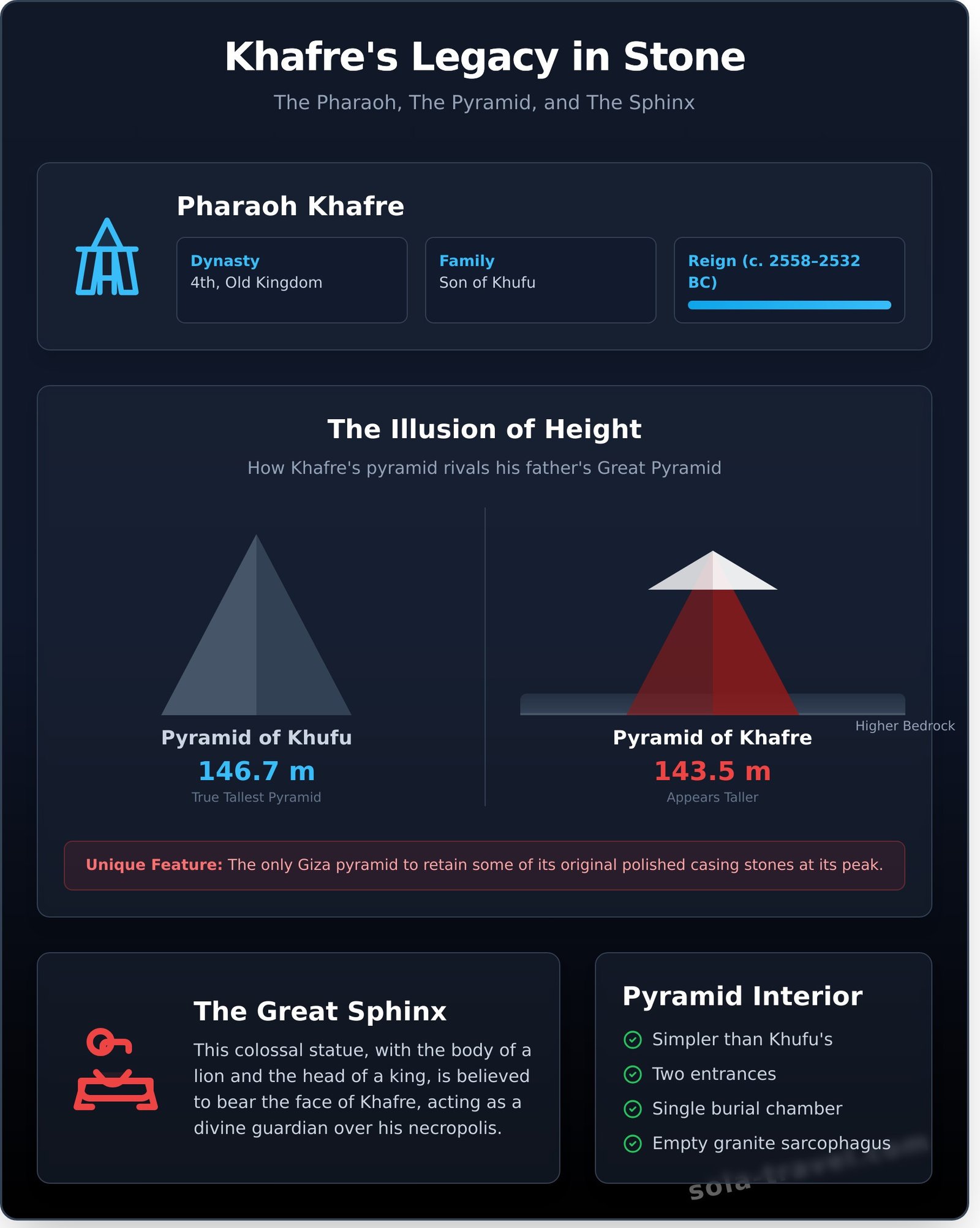
Meet the Fourth Dynasty king who forever left his mark on the sands of Giza. Khafre, known to the ancient Greeks as Chephren, was a son of the legendary Pharaoh Khufu, the builder of the Great Pyramid. His reign was defined by the immense challenge of following his father’s monumental legacy, a challenge he met by commissioning some of the most enduring structures in human history.
Khafre’s Place in Egypt’s Royal Family
Understanding Khafre’s story means placing him within the powerful lineage of the Old Kingdom’s pyramid-building age. As Khufu’s son, he was born into a tradition of god-kings who commanded vast resources and manpower. His reign continued this golden era of construction, solidifying the Giza plateau as the eternal necropolis for Egypt’s most powerful rulers.
How Long Did Khafre Reign?
While exact dates are debated by historians, Khafre is believed to have ruled Egypt for over two decades, around 2558-2532 BC. During this time, Egypt was a prosperous and highly organized state, capable of undertaking massive building projects that required incredible logistical skill, from quarrying giant stone blocks to feeding thousands of skilled workers.
The Pyramid of Khafre: An Architectural Marvel
At first glance, Khafre’s pyramid often appears to be the tallest on the plateau. This is a clever illusion! While slightly shorter than his father’s Great Pyramid, it was built on a higher bedrock foundation, giving it the appearance of greater height. This towering monument has several key features that set it apart, most notably the beautiful, smooth casing stones that still cling to its peak-a breathtaking glimpse of how all the pyramids once looked.
(Image Suggestion: A diagram of Khafre’s pyramid complex, highlighting the main pyramid with its remaining casing stones, the causeway leading down to the Valley Temple, and the nearby Great Sphinx.)
Inside the Second Pyramid: Chambers and Passageways
Compared to the complex interior of the Great Pyramid, Khafre’s tomb features a simpler design. Two entrances lead to a descending passageway that opens into a single burial chamber. It was here that a magnificent, though empty, granite sarcophagus was discovered. Despite the pyramid’s grandeur, Khafre’s mummy has never been found, its fate lost to time and the actions of ancient tomb robbers.
The Mortuary Temple and Valley Temple
A pyramid was never just a tomb; it was the heart of a vast complex dedicated to the king’s spirit. At the base of Khafre’s pyramid lie the ruins of his Mortuary Temple, where priests performed daily rituals and left offerings for his soul. Connected by a long causeway is the Valley Temple, a remarkably well-preserved structure built from massive limestone blocks and faced with red granite. It was here, within its silent halls, that one of ancient Egypt’s greatest artistic treasures was discovered: the iconic diorite statue of Khafre, seated majestically on his throne.
The Great Sphinx: Did Khafre Create This Icon?
Gazing eternally towards the rising sun is the Great Sphinx, the enigmatic monument of a lion with a human head. For centuries, its origin was a profound mystery, but today, most Egyptologists agree that this colossal statue was carved for Pharaoh Khafre. The face of the Sphinx bears a striking resemblance to the statues of Khafre found in his Valley Temple. Its purpose was likely to act as a divine guardian, a powerful symbol of the king’s royal and spiritual authority watching over the entire Giza pyramid complex. Seeing it in person is a truly unforgettable experience. Why not see the Sphinx up close on a Cairo tour!
Experience Khafre’s Legacy Today
Visiting the Giza Plateau is more than a tour; it’s a journey thousands of years back in time. You can walk the same ground as pharaohs and priests and feel the sheer scale of their vision. When you visit, be sure to see Khafre’s pyramid and the Sphinx, but don’t miss the chance to see his famous diorite statue in the Egyptian Museum in Cairo, a masterpiece of art that perfectly captures his serene power.
Planning Your Visit to the Giza Necropolis
To make the most of your trip, try to visit early in the morning to avoid the biggest crowds and the midday heat, which also provides the best light for stunning photographs. When you stand before the pyramids, look for the subtle differences between them-the remaining casing stones on Khafre’s, the sheer size of Khufu’s, and the smaller scale of Menkaure’s. To truly understand what you’re seeing, consider a guided tour. An expert guide can reveal the hidden stories and historical secrets you would otherwise miss.
FAQs About Khafre’s Pyramid
Which pyramid at Giza belongs to Khafre?
Khafre’s pyramid is the second-largest of the three main pyramids at Giza, located centrally on the plateau between the Great Pyramid of Khufu and the smaller Pyramid of Menkaure.
Is Khafre’s pyramid bigger than Khufu’s?
No, although it often appears taller because it was built on higher ground. The Great Pyramid of Khufu is actually the largest of the three.
Can you go inside the Pyramid of Khafre?
Yes, access to the interior of the pyramids is often available to visitors, though tickets are usually required and can be limited. The entrance leads down a passage to the burial chamber.
Is Khafre really the face of the Great Sphinx?
While there is no definitive inscription, the vast majority of archaeologists and Egyptologists believe the face of the Sphinx is a portrait of Pharaoh Khafre, due to its location and stylistic resemblance to his other statues.
Where is the famous statue of Khafre located today?
The magnificent diorite statue of Khafre, showing him seated with the falcon god Horus protecting his head, is one of the main attractions at the Egyptian Museum in Cairo.
Are you ready to witness the awe-inspiring legacy of Pharaoh Khafre for yourself? With over 25 years of experience, Sola Travel is dedicated to crafting the perfect Egyptian adventure for you. Our expert guides bring history to life, and with our best price guarantee, you can be sure you’re getting an incredible value. Explore our unforgettable Giza Pyramids and Sphinx tours and book the journey of a lifetime today!


Comment (0)