
Skipping the Qena desert because of the drive is the biggest mistake you’ll make during your 2026 Red Sea holiday. It’s true that a day trip to Dendera and Abydos from Hurghada involves a 5:00 AM departure and roughly 450 kilometers of travel. You likely worry about losing an entire day to a van seat or wonder if these sites can actually compete with the famous tombs in Luxor. We know you want to ensure your vacation time and your E£ 4,800 investment in a private tour result in something truly magical rather than just a long commute.
The truth is that the vibrant indigo ceilings of Dendera and the mysterious carvings at Abydos offer a level of detail you won’t find anywhere else in Egypt. This guide proves why this journey is the most rewarding cultural adventure available from the coast. We’ll outline the exact logistics for the 14 hour day, explain the architectural secrets of the Temple of Hathor, and give you the confidence to book a bespoke experience that prioritizes your comfort and curiosity. Get ready to see the best-preserved art in the ancient world.
Beyond the Red Sea: Why Dendera and Abydos are Egypt’s Best-Kept Secrets
The Qena Governorate serves as the spiritual heart of Upper Egypt, yet it remains largely untouched by the massive tour buses that clog the streets of Cairo. While most travelers spend their holiday focused on the coast, a day trip to dendera and abydos from hurghada offers a rare portal into the unfiltered past. These sites are the ultimate “hidden gems” of the Nile Valley. Recent visitor data from 2024 indicates that these temples see 90% fewer tourists than the heavy hitters in Luxor or Giza. This creates an atmosphere of profound silence that’s nearly impossible to find at the Pyramids.
As we move into 2026, travel trends are shifting toward “slow travel” and deep historical immersion. Explorers don’t just want to snap a photo; they want to feel the weight of the stone. Dendera and Abydos cater perfectly to this desire. Unlike the weathered, sun-bleached surfaces of Karnak, the Temple of Hathor at Dendera retains its original astronomical ceilings. The vivid blues and rich ochres look as though the artists finished their work only yesterday. It’s a startling contrast that makes the ancient world feel immediate and alive. For those who value authenticity over a crowded checklist, this journey is the smartest choice you’ll make in Egypt.
The “Luxor Fatigue” Solution
Many repeat travelers are choosing Qena over the West Bank in 2026 to escape what locals call “Luxor Fatigue.” The pressure of navigating thousands of visitors can diminish the majesty of the Pharaohs. Choosing a day trip to dendera and abydos from hurghada provides a psychological reset. You can explore the ancient city of Abydos without feeling rushed by a line of people behind you. This site was the primary cult center for Osiris, the god of the afterlife. The lack of crowds allows for a genuine connection to the spiritual energy of the Seti I Temple. It’s a place where you can actually hear your own footsteps echoing through the 3,000-year-old halls. For a modest entry fee of approximately E£ 200 to E£ 300, you get a world-class archaeological experience that feels like a private viewing.
A Journey Through the Eastern Desert
The adventure begins long before you reach the Nile. Your morning departure involves a 220-kilometer drive that transitions from the turquoise sparkles of the Red Sea into the rugged, golden peaks of the Eastern Desert. This route isn’t just a modern highway; it follows the ancient trade paths that connected the Roman port of Myos Hormos to the river. Watching the landscape shift is a highlight of the trip. By roughly 8:30 AM, the harsh desert cliffs suddenly give way to the lush, emerald green of the Nile Valley. This dramatic change illustrates why the ancients viewed the river as the bringer of life. The drive takes about 3.5 hours, but the constant change in scenery ensures the time passes quickly. You’ll see traditional mud-brick villages and donkey carts that look like they’ve been plucked from a different century. It’s a visual narrative of Egypt’s enduring relationship with its geography.
- Crowd Control: Enjoy sites with 90% less foot traffic than Luxor.
- Pristine Preservation: See 2,000-year-old colors that haven’t faded.
- Value: Private tours often start around E£ 5,500 per person, including transfers and guides.
- Expertise: Access specialized knowledge about the cult of Hathor and Osiris.
Dendera Temple: A Masterclass in Ptolemaic Art and Astronomy
Dendera remains one of the most intact temple complexes in Egypt. Most visitors find the Temple of Hathor breathtaking because the roof is still mostly there. This preservation protects the intricate details inside from the harsh desert sun. Booking a day trip to dendera and abydos from hurghada allows you to witness the transition from Pharaonic traditions to Greco-Roman influence. The site feels alive, almost as if the priests left only yesterday. It’s a journey into the heart of ancient Egyptian spirituality that few other sites can match.
The 18 massive columns in the Great Hypostyle Hall dominate the entrance. Each pillar is topped with the four-sided face of Hathor, the goddess of love, music, and joy. These are known as Hathoric columns. They resemble the sistrum, a sacred rattle used in temple rituals to ward off chaos. The scale is impressive; each column reaches about 15 meters high. You’ll notice the goddess has cow ears, symbolizing her nurturing nature and her connection to the celestial cow that birthed the sun.
Many travelers ask about the “Dendera Light” found in the underground crypts. These narrow passages are tight but worth the squeeze for the high-quality reliefs. You’ll see carvings that some fringe theorists claim represent ancient lightbulbs or electricity. Archaeological facts tell a different story. These carvings depict the birth of Harsomtus, the “Uniter of the Two Lands,” emerging from a lotus flower in the form of a snake. It’s a profound theological symbol of the rising sun and the creation of the universe. We’ve spent 25 years helping guests separate myth from the even more fascinating reality of Egyptian theology.
The Dendera Zodiac and Ancient Skies
Climb the stairs to the roof chapels to find the astronomical room. The Dendera Zodiac is the only circular zodiac found in an ancient Egyptian temple. While the original was removed by French explorers in 1821 and now sits in the Louvre, the replica on-site is stunningly detailed. It shows how Ptolemaic Egyptians blended Greek planetary knowledge with their own 36 decans. It’s a celestial map that guided their religious calendar for centuries.
Colors of the Gods: The Great Hypostyle Hall
The interior of the temple underwent a massive transformation between 2023 and 2026. Specialized restoration teams used fine brushes and chemical solutions to strip away centuries of black soot and grease. The results are magical. You can now see the original “Egyptian Blue” and vivid reds on the ceiling. These colors depict the goddess Nut swallowing the sun at night and giving birth to it at dawn. It’s an unforgettable sight that was hidden for nearly 2,000 years.
Don’t miss the exterior rear wall before you leave. Here, you’ll find the famous Cleopatra Relief. It shows Cleopatra VII and her son, Caesarion, making offerings to the gods. It’s one of the few confirmed contemporary depictions of the legendary queen in all of Egypt. Nearby, the Mammisi or birthing houses celebrate the divine birth of the pharaoh’s heir. If you’re ready for a journey through time, our bespoke Egypt tours offer the best value and expert guides to explain every detail. We guarantee a seamless experience from your hotel in Hurghada to these ancient gates.
Abydos and the Temple of Seti I: The Gateway to the Afterlife
Abydos served as the most sacred site in ancient Egypt for over 3,000 years. It wasn’t just a city; it was the spiritual home of Osiris, the lord of the underworld. Every ancient Egyptian, from humble farmers to powerful pharaohs, dreamed of being buried here. If they couldn’t afford a tomb, they erected a cenotaph or memorial stone to ensure they stayed close to Osiris in the afterlife. A day trip to dendera and abydos from hurghada brings you to the heart of this devotion. The Temple of Seti I, built during the 19th Dynasty around 1290 BC, remains the centerpiece of this holy ground.
You’ll quickly see why historians call this temple the peak of Egyptian relief carving. Unlike the deep-cut carvings found in Luxor, the figures here are rendered in delicate, raised relief. The limestone surfaces display a level of detail that captures individual fingernails and the fine texture of linen robes. The temple also features a unique L-shaped floor plan. Most Egyptian temples follow a straight, symmetrical path from the entrance to the sanctuary. Seti I’s architects built a 90-degree turn into the structure to avoid disturbing the much older Osireion located directly behind it.
The spiritual heart of the building consists of seven separate chapels. Each one honors a specific deity: Osiris, Isis, Horus, Amun-Ra, Ra-Horakhty, Ptah, and the deified Seti I himself. These sanctuaries still hold vibrant colors that haven’t faded in three millennia. Walking through these halls feels like stepping into a private audience with the gods. It’s a quiet, powerful experience that contrasts with the crowded sites in the Nile Valley, making this day trip to dendera and abydos from hurghada a highlight for any history lover.
The Abydos King List: A Pharaoh’s History Book
Inside a long corridor, you’ll find the famous Abydos King List. This wall contains the names of 76 kings, starting from Menes, the first pharaoh of the First Dynasty. It’s a massive stone record that helped 19th-century archaeologists reconstruct the chronological order of Egypt’s rulers. However, this list isn’t just a history book; it’s a political statement. The scribes practiced “Damnatio Memoriae,” intentionally excluding “heretic” or “illegitimate” rulers like Hatshepsut and Akhenaten to maintain a sanitized royal lineage. This specific wall remains the most vital historical document in Upper Egypt for understanding how the pharaohs viewed their own heritage.
The Mystery of the Osireion and the “Helicopter” Hieroglyphs
Behind the main temple lies the Osireion, an enigmatic structure that looks completely different from the rest of the complex. It’s built with massive red granite blocks reminiscent of the Old Kingdom’s Valley Temple at Giza. The Osireion sits at a water table level 15 meters lower than the main temple, suggesting it was designed to be partially submerged to represent the primeval mound of creation rising from the waters. While some theorists suggest “ancient aliens” built the site, the evidence points to a sophisticated understanding of hydraulics and architectural symbolism.
You might also hear about the “helicopter” and “tank” hieroglyphs found in the first hypostyle hall. These shapes look remarkably like modern machinery, but the reality is more grounded in ancient politics. They are a palimpsest, a result of Ramesses II over-writing his father Seti I’s name with his own titles. Over time, the plaster fell away, leaving a mashup of two different sets of hieroglyphs that coincidentally look like 20th-century vehicles. Don’t let the myths distract you from the genuine engineering marvels of the 19th Dynasty.
The Hurghada to Dendera Logistics: Making the Long Drive Seamless
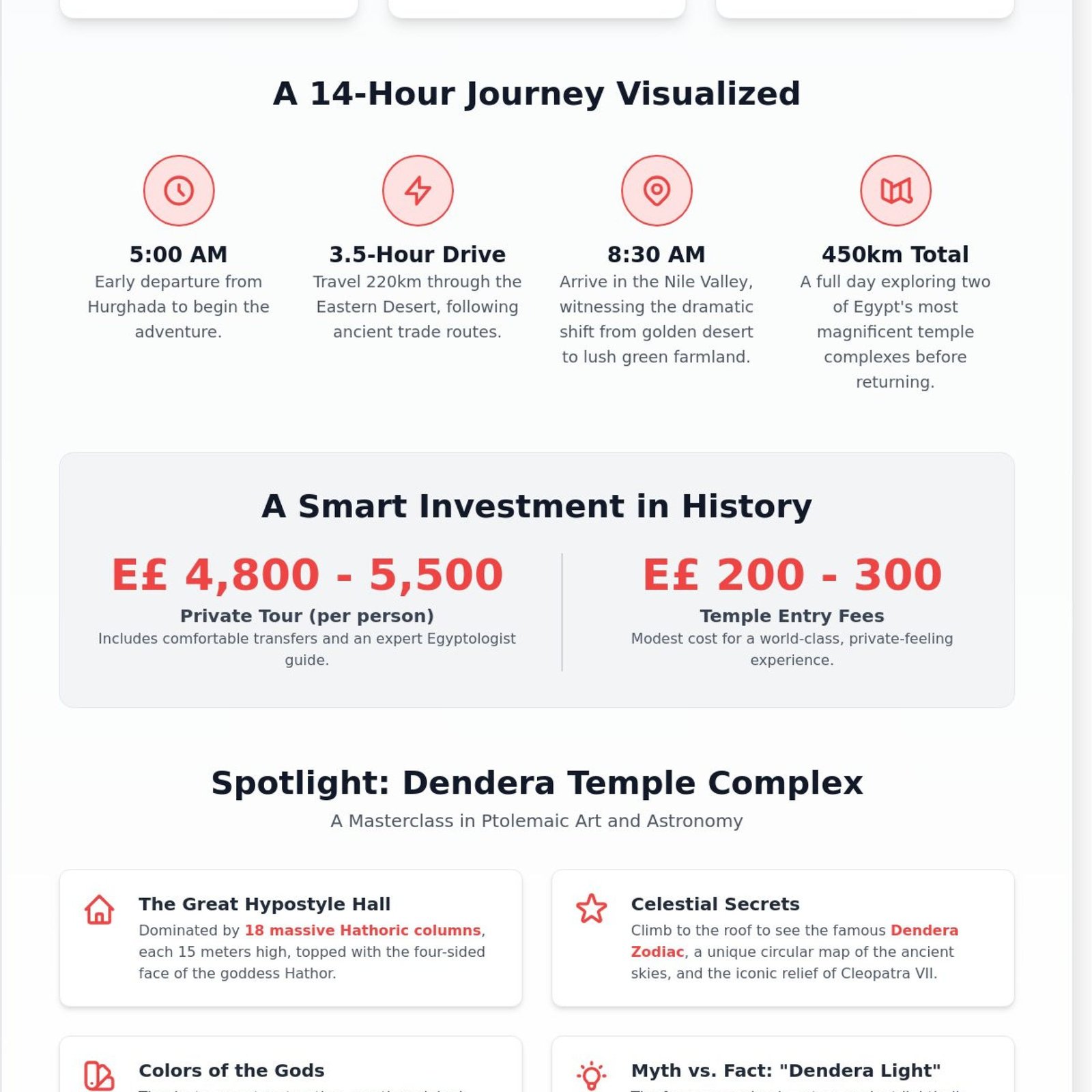
Success on a day trip to dendera and abydos from hurghada depends entirely on your morning alarm. You’ll need to leave your hotel by 5:00 AM sharp. This early start isn’t just about beating the crowds; it’s about escaping the punishing midday sun that often hits 42°C in Upper Egypt by noon. Leaving early ensures you reach Dendera by 8:30 AM, giving you the best light for photos of the vibrant blue ceilings before the heat becomes intense.
The drive follows the Safaga-Qena road. This route cuts through the heart of the Red Sea Mountains. You’ll see jagged peaks and vast desert plains that look like another planet. It’s a 230-kilometer journey to the first stop. While the roads are paved and well-maintained as of January 2024, the terrain is remote. You won’t find many facilities between the coast and the Nile Valley, so a reliable vehicle is your biggest asset.
Choosing your transport carefully changes the entire experience. Large bus convoys are often slower and restricted by rigid schedules. We recommend private transport in a modern, air-conditioned van. Private cars move faster through security checkpoints and allow you to stop for photos or coffee whenever you like. A private trip usually saves you 90 minutes of travel time compared to a standard tour bus.
For the 2026 Upper Egypt climate, your packing list must be tactical. Bring at least 3 liters of water per person, even if your tour provides some. Pack high-SPF sunscreen, a wide-brimmed hat, and portable cooling fans. Don’t forget E£500 in small Egyptian Pound notes for tips, local snacks, or bathroom access at rest stops. Lightweight linen clothing is your best defense against the dry heat of the Qena governorate.
Maximizing Comfort on the 8-Hour Round Trip
Comfort matters when you’re spending eight hours on the road. Professional drivers understand the rhythm of the Safaga-Qena highway. They know the best rest stops, like the “Kilometre 85” station, where you can find clean facilities and decent local coffee for about E£65. These breaks are vital for stretching your legs. Inside the vehicle, keep the climate control steady. Staying hydrated with electrolyte-rich drinks helps you avoid the fatigue that often comes with the Nile Valley heat.
Is One Day Enough? The Itinerary Breakdown
Time management is the secret to a perfect day trip to dendera and abydos from hurghada. We use the 3-2-1 rule to keep things on track. You’ll spend 3 hours exploring the massive Dendera complex, 2 hours at the Temple of Seti I in Abydos, and 1 hour for a traditional Egyptian lunch in a local Qena restaurant. This schedule accounts for the security checkpoints near the “Qena Convoy” zones. These stops are quick for private cars but require your passport or ID. Booking a private guide is essential here. They navigate the security protocols and explain the complex hieroglyphics quickly, ensuring you don’t waste a single minute of your window in the valley.
Ready to see the most colorful temples in Egypt without the stress of planning? Book your private luxury transfer today and enjoy a seamless journey to the past.
Book Your Bespoke Adventure: Why Sola Travel Defines Luxury in the Desert
Sola Travel brings 25 years of ground-level expertise to every expedition we lead. Since we began our operations in the Nile Valley in 1999, we’ve focused on one core mission: we create the trips you love. We don’t believe in generic sightseeing. Instead, we focus on high-value, personalized itineraries that respect your time and curiosity. A day trip to dendera and abydos from hurghada shouldn’t be a generic bus ride; it’s a deep dive into the heart of ancient theology and astronomical science. Our longevity in the Egyptian market means we’ve built the relationships necessary to provide a seamless, premium experience that other operators simply can’t match.
The Sola Advantage starts with our people. Our private Egyptologists are the backbone of your journey. These professionals don’t just recite dates or names from a script. They’re passionate storytellers who decode the complex astronomical charts at Dendera and explain the mysterious architecture of the Osireion with academic precision. You’ll have their undivided attention, allowing you to ask questions and explore theories that interest you personally. We’ve spent over two decades perfecting this balance of luxury and education, ensuring every guest returns with more than just photos.
Planning a holiday in Egypt can feel overwhelming, but we’ve simplified the process to keep your experience stress-free. Our “Pay Now or Pay Later” policy is a cornerstone of our customer-centric approach. This flexibility allows you to lock in your preferred dates and secure our best rates without immediate financial pressure. We guarantee the best price for your private group, often offering rates that provide ten times the value of a standard crowded bus tour. You won’t find a more reliable partner for your Red Sea adventures.
The Sola Travel Private Experience
Most companies trap you in unrequested papyrus or perfume shops to collect commissions from your purchases. We’ve banned this practice entirely. Your time is valuable, so we focus exclusively on the temples. This customized pacing means you can spend an extra hour studying the Dendera Zodiac or exploring the subterranean levels of Abydos without a group leader rushing you. Our transport standards are equally strict. We only use late-model, air-conditioned premium vehicles from 2022 or newer, each undergoing a rigorous safety screening to ensure comfort on the desert roads.
Start Your Journey Magical Today
You can secure your 2026 adventure now to take advantage of our current 50% discounts for private groups. These prices are designed to make luxury accessible to every traveler who wants to see the real Egypt. You can book with total confidence thanks to our 24-hour free cancellation guarantee. If your plans change, you get a full refund in E£ without any hidden fees or complicated paperwork. Your perfect day trip to dendera and abydos from hurghada is just a click away, backed by 25 years of excellence and a passion for unforgettable journeys.
Ready to explore? Book your private day trip to Dendera and Abydos with Sola Travel and experience the difference that expert planning makes.
Secure Your Place in Ancient History Today
Your journey through Egypt’s sacred history is just a short drive away. You’ll witness the vibrant blue astronomical ceilings of Dendera and the mysterious carvings of Seti I at Abydos. These sites remain the best-kept secrets of the Nile Valley for 2026. A day trip to dendera and abydos from hurghada doesn’t have to be a logistical challenge when you have experts handling the details. We’ve spent 25 years perfecting these routes to make your travel seamless.
Sola Travel brings a quarter-century of excellence to your desert expedition. We include expert Egyptologist guides on every private tour to ensure you don’t miss a single detail. You get our Best Price Guarantee on all Hurghada excursions. This ensures you receive the highest value for your E£ without compromising on luxury. It’s time to swap the beach for the breathtaking temples of the pharaohs.
Explore our Dendera and Abydos Private Tours, Save up to 50% today!
We create the trips you love. Book your spot now and prepare for a magical experience that stays with you forever.
Frequently Asked Questions
How long is the drive from Hurghada to Dendera and Abydos?
The drive from Hurghada to Dendera takes approximately 3.5 hours, covering 230 kilometers of desert and Nile Valley roads. Reaching Abydos requires an additional 2 hours of travel time from Qena. We use modern, air-conditioned vehicles to ensure your 12-hour round journey remains comfortable and relaxing. Our expert drivers prioritize your schedule so you spend more time exploring and less time on the road.
Is it safe to travel from Hurghada to Qena and Abydos in 2026?
Yes, it’s safe to travel to Qena and Abydos in 2026 as the Egyptian Ministry of Tourism maintains strict security protocols for all 450 daily tourist routes. Sola Travel has provided secure excursions for 25 years, using vetted drivers and GPS-tracked vehicles for every guest. Local authorities monitor these paths 24/7 to guarantee a worry-free adventure. We prioritize your well-being so you can focus on the magic of the temples.
Can I see both Dendera and Abydos in a single day trip from the Red Sea?
You can definitely see both temples during a single day trip to dendera and abydos from hurghada. This 15-hour itinerary starts at 5:00 AM to maximize your time at these historical sites before the afternoon heat peaks. You’ll spend about 2 hours exploring the vibrant ceilings at Dendera and another 2 hours at Abydos. It’s an intense but rewarding journey that captures the very best of Upper Egypt’s hidden gems.
What should I wear when visiting the temples in Upper Egypt?
Wear lightweight cotton clothing and comfortable walking shoes with good grip for the ancient stone floors. While there’s no strict dress code, 85% of visitors prefer modest attire that covers shoulders and knees to stay cool and respect local customs. Don’t forget a wide-brimmed hat and high-SPF sunscreen to protect yourself from the desert sun. We want you to feel comfortable while capturing those perfect, Instagram-ready photos.
Are there many stairs or difficult climbs at Dendera and Abydos?
Dendera features a famous spiral staircase with 30 shallow steps leading to the roof, while the Abydos complex is mostly flat. You’ll encounter some uneven stone flooring and narrow passages in the seven chapels of Seti I. Most visitors find the physical effort moderate, as 90% of the main temple areas are easily reachable without intense climbing. Our guides move at your pace to ensure you don’t miss a single detail.
Is lunch included in the Sola Travel day trip package?
Yes, a high-quality lunch is included in every package to ensure you stay energized throughout your journey. We provide a set menu featuring fresh local Egyptian cuisine at a vetted restaurant in Qena, valued at approximately E£ 450 per person. We also provide plenty of bottled water and snacks during the drive to keep you refreshed. It’s part of our commitment to creating the trips you love with zero hidden costs.
What is the best month to visit Dendera and Abydos to avoid the heat?
The best months to visit are from October to April when daytime temperatures range between 20°C and 28°C. During the peak summer months of July and August, temperatures often exceed 40°C, which makes midday exploration quite challenging. Booking your trip during the winter season ensures a 100% more comfortable experience while viewing the astronomical ceilings. You’ll enjoy the crisp desert air and perfect lighting for your temple photography.
Do the temples have accessible facilities for travelers with limited mobility?
Both temples have limited accessibility, though the main courtyards and primary halls are reachable for those with minor mobility issues. Approximately 60% of the Dendera complex is accessible via flat paths, but the famous crypts and roof sections require navigating narrow stairs. We can arrange specialized assistance and a private vehicle to make your journey as smooth as possible. Just let us know your requirements and we’ll handle the rest.

Comment (0)