
Last March, a photographer named Sarah waited three hours at Karnak only to realize the sun sets behind a massive stone wall she didn’t anticipate, missing the golden hour entirely. It’s incredibly frustrating when you’ve planned a journey to Egypt and the 20 minute window of perfect light slips away because of a simple logistical error. We agree that your time in this magical city should be spent capturing beauty, not fighting for a clear view. This guide reveals the best spots for sunset photos in Luxor so you can secure those unforgettable, professional shots without the stress of crowds or bad timing.
You’ll discover exactly where to stand for that iconic glow and which lenses will handle the unique desert haze. We’re providing a curated list of GPS-worthy locations, technical tips for river lighting, and a 2026 itinerary designed for maximum efficiency. Whether you’re shooting from a traditional felucca or the heights of the West Bank, you’ll have everything you need for a successful photography adventure. Let’s make sure your next trip to Luxor is your most visually stunning one yet.
Why Luxor is the Ultimate Destination for Sunset Photography
Luxor isn’t just a city; it’s a visual masterpiece. Photographers flock here because the dry desert air acts like a natural filter. This creates the famous “Theban” light, a spectrum of deep ambers and violets you won’t find in more humid climates. When you’re searching for the best spots for sunset photos in Luxor, you’re choosing between two distinct worlds. The East Bank, traditionally the Land of the Living, offers vibrant temple life and river activity. The West Bank, the Land of the Dead, provides the dramatic, jagged silhouettes of the mountains and ancient tombs. This contrast allows you to use 3,000-year-old architecture to anchor your landscape shots. Unlike Cairo, where urban haze can sometimes soften the horizon, Luxor’s southern location ensures cleaner, sharper color gradients. It’s the primary reason this region is celebrated as the world’s greatest open-air museum.
The Science of the Egyptian Golden Hour
The magic of an Egyptian sunset happens because of atmospheric dust. Fine particles from the Sahara desert scatter short-wavelength blue light, leaving behind the intense oranges and purples that define the region. In Luxor, the “Blue Hour” feels uniquely extended. Because the horizon is flat and the air is thin, the transition from gold to deep indigo lasts about 15 minutes longer than in northern Europe. Planning for 2026 is especially important. We’re currently in the peak of Solar Cycle 25, which increases atmospheric activity and often results in more vivid, fiery sky colors. You’ll want your camera gear ready and your tripod leveled at least 45 minutes before the official sunset time to catch the full transition.
Planning Your Route for Maximum Light
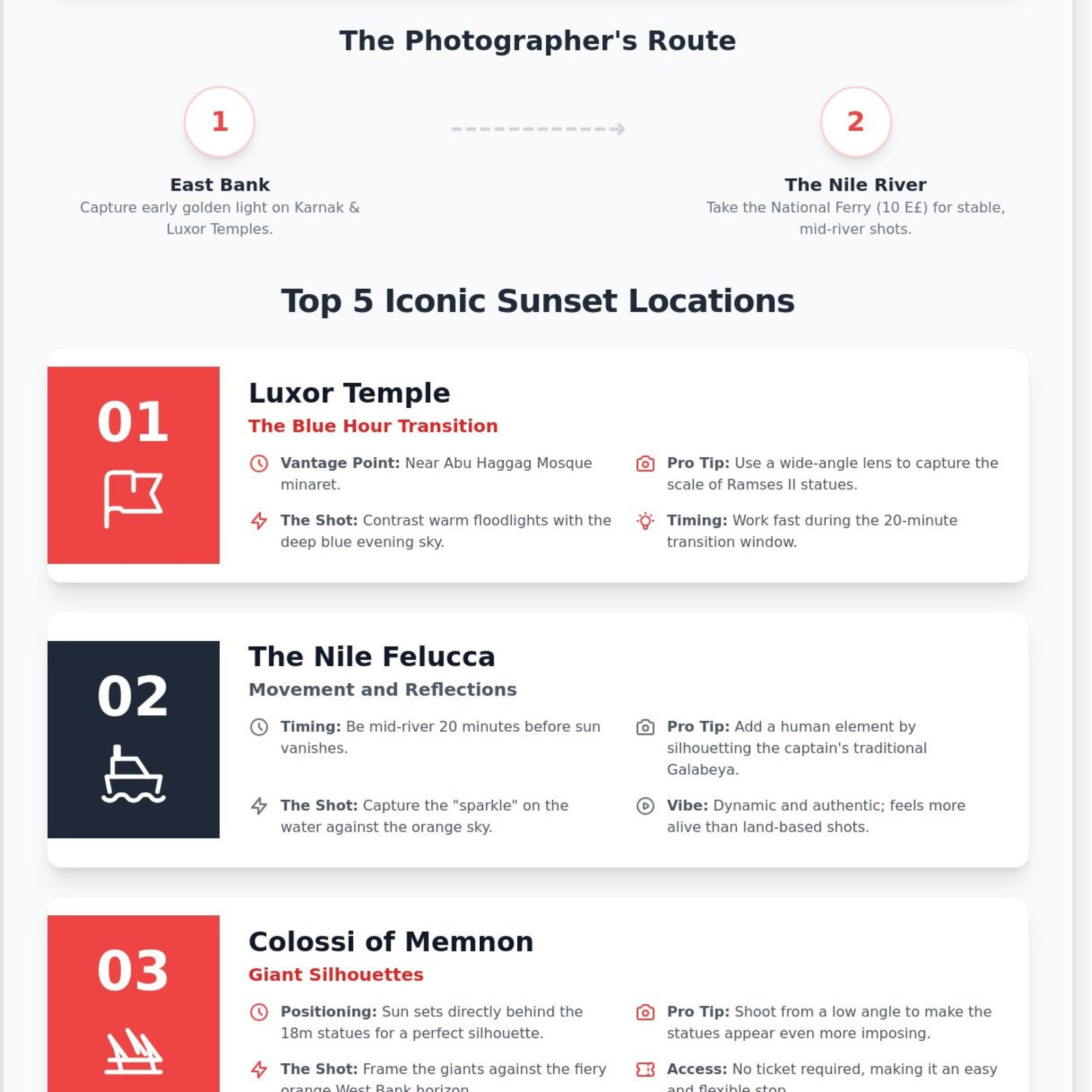
Professional photographers always start their afternoon on the East Bank. You can capture the early golden light hitting the massive, textured columns of Karnak or Luxor Temple. As the sun dips lower, make your move to the river. Use the local National Ferry to reach the West Bank. It costs only 10 E£ and serves as a stable, mobile platform for mid-river shots. Watching the sun drop behind the Theban Hills from the water is a core experience for any creator. For a stress-free journey between these historic sites, check out our Egypt tour packages. We handle the logistics so you can focus on your lens. Finding the best spots for sunset photos in Luxor is much easier when your transport is already organized and waiting for you.
The Top 5 Iconic Sunset Locations in Luxor
Luxor transforms as the sun dips below the horizon. It’s the golden hour every photographer dreams of. To find the best spots for sunset photos in Luxor, you need to know exactly where the light hits the ancient stone. We’ve mapped out five locations that offer a mix of history, drama, and perfect lighting for your 2026 portfolio.
Luxor Temple: The Blue Hour Transition
This temple stays open late, which is a gift for photographers. You can watch the sun fade and the floodlights flicker on simultaneously. The best vantage point is near the Abu Haggag Mosque minaret within the complex. You’ll catch the sharp contrast between the warm yellow glow of the pylons and the deep blue of the evening sky. Use a wide-angle lens. It helps capture the massive scale of the Ramses II statues against the changing atmosphere. The transition usually lasts about 20 minutes, so work quickly to balance the artificial and natural light.
The Nile Felucca: Movement and Reflections
Nothing beats a traditional wooden boat on the water. You’ll want to be mid-river about 20 minutes before the sun vanishes. This timing allows you to capture the “sparkle” on the water without overexposing the sky. Focus on the captain’s traditional Galabeya to add a human element to your shots. It creates a powerful silhouette against the orange sky. If you want to experience this yourself, you can explore our Nile sunset tours for the perfect photo op. The movement of the boat adds a dynamic feel to your frames that land-based shots lack.
The Colossi of Memnon: Giant Silhouettes
These twin statues represent Amenhotep III and stand 18 meters high. They face east, meaning the sun sets directly behind them over the Theban Hills. This positioning creates a perfect silhouette against a burning West Bank horizon. The horizon often turns a deep, fiery orange in the dry desert air. You don’t need a ticket to photograph these, making it an easy addition to your evening schedule. Aim for a low angle to make the statues look even more imposing against the sky.
The Winter Palace Gardens: Victorian Elegance
The Sofitel Winter Palace opened in 1886 and its gardens offer a different vibe. You get lush greenery, Victorian architecture, and the soft Egyptian sun. The light filters through palm trees, creating dappled patterns on the manicured lawns. It’s one of the best spots for sunset photos in Luxor if you want a refined, colonial aesthetic. The pink facade of the hotel glows during the final minutes of daylight, providing a soft, warm palette for portraits.
Hatshepsut Temple: Dramatic Shadows
The limestone cliffs of Deir el-Bahari create a massive natural backdrop for this mortuary temple. As the sun goes down, the colonnaded terraces cast long, geometric shadows across the courtyard. You’ll see the sharp contrast between the sun-bleached stone and the dark mountain recesses. It’s a dramatic look that emphasizes the architecture’s symmetry. The light highlights the texture of the rock in a way that the harsh midday sun simply cannot replicate.
Hidden Gems: Off-the-Beaten-Path Viewpoints
Escape the usual tourist clusters and find a fresh perspective on the ancient city. Finding the best spots for sunset photos in Luxor often means looking beyond the main temple gates. These hidden gems offer a quiet atmosphere where you can focus on your craft while the sky turns to fire over the Nile.
Banana Island: A Tropical Sunset
Board a traditional felucca or a small motorboat from the main docks for a short 15 minute journey to Gezira el-Moz. This spot provides a unique contrast to the desert landscape. To get the perfect shot, frame the setting sun through the dense palm fronds. Use the Nile as a leading line to draw the viewer’s eye directly toward the horizon. It’s a fantastic location for lifestyle photography and portraits, as the golden hour light filters through the tropical greenery to create soft, flattering skin tones.
The Theban Hills: Aerial Perspectives
For a true adventure, hike the ridge trail located above the Hatshepsut Temple. This vantage point offers a panoramic, “God-eye” view of the entire Nile Valley as it transforms into a sea of gold. You’ll see the green farmland meet the harsh desert in a sharp, beautiful line. For 2026, remember that trekking these trails requires a local guide for safety and proper permits. Start your ascent at least 90 minutes before sunset to reach the peak before the light peaks. The scale of the landscape from this height is unmatched for wide-angle photography.
Medinet Habu: Deep Reliefs and Long Shadows
While many photographers flock to the Ramesseum, Medinet Habu offers something special for those who stay late. The temple is famous for its exceptionally deep relief carvings. When the sun hits these walls at a low angle, the shadows become elongated and dramatic. This creates a three-dimensional effect that makes the ancient stories carved into the stone practically jump out of the frame. Focus on the high-contrast textures of the hieroglyphs during the final 30 minutes of light.
The Corniche North: Quiet Reflections
Avoid the crowds by heading to the northern stretch of the Corniche, away from the heavy cluster of cruise ships. This area is a prime choice for one of the best spots for sunset photos in Luxor because it offers an unobstructed view of the West Bank mountains. You can capture the silhouettes of traditional sailboats without the visual clutter of modern tourism. It’s a peaceful, cost-free location that allows you to use a tripod and take your time with long exposure shots of the water.
- Banana Island: Best for lifestyle and tropical textures.
- Theban Hills: Best for wide-angle panoramas and scale.
- Medinet Habu: Best for high-contrast architectural details.
- Corniche North: Best for clean, minimalist landscapes.
Pro Photography Tips for Luxor’s Unique Light
Luxor’s light behaves differently than anywhere else on Earth. The combination of desert haze and ancient stone creates a glow that photographers call “Egyptian Gold.” To capture the best spots for sunset photos in Luxor, you need to master your white balance first. Set your camera to 6000K or use the “Shade” preset. This prevents your camera from neutralizing those deep oranges and reds that make the temples look magical. It’s the easiest way to ensure your RAW files reflect the actual warmth of the Sahara.
Your lens choice matters when you’re trekking through the West Bank. A 24-70mm f/2.8 lens is your best tool. It’s wide enough for the massive pylons at Karnak and has enough reach to capture the intricate hieroglyphics high on the walls. In the Valley of the Kings, this range allows you to frame the desolate limestone cliffs against the darkening sky without constantly switching glass and exposing your sensor to the elements. Most pros find they spend 85% of their time within these focal lengths.
Managing dynamic range is the biggest challenge here. The gap between a dark tomb entrance and the blazing horizon is often 10 stops of light. Use your camera’s HDR mode or shoot three bracketed frames. This ensures you keep detail in the shadows of the pillars while preserving the violet hues of the sky. For an iconic look, try the silhouette technique. Position a palm tree or a colossal statue of Ramses II directly between your lens and the sun. Underexpose by 1.5 stops to turn the stone into a sharp, black outline against the fire-colored horizon.
Post-processing should be subtle. Enhance the warmth in the highlights but keep your shadows neutral. This maintains the authentic feel of the desert. If you want to see these sights for yourself, explore our bespoke Luxor tours and find your perfect shot.
Dealing with Sand and Dust
The Saharan environment is harsh on professional gear. A high-quality UV filter is mandatory. A basic filter costs around E£ 850, which is a small price to protect a lens worth E£ 45,000 from abrasive sand. Never change your lens in the open air; the fine dust particles settle on your sensor in seconds. If you see spots on your images, use a professional sensor cleaning kit, which retails for about E£ 1,400 in specialized shops. Keep your spare batteries in a cool, insulated pouch. Desert heat can reduce battery life by 18% during a long afternoon shoot.
Smartphone Photography Hacks
You don’t need a heavy DSLR to get incredible results at the best spots for sunset photos in Luxor. When the temples light up after dark, use “Night Mode” to stack exposures for a crisp, noise-free image. If you’re shooting a Felucca on the Nile, hold down the shutter button to use “Burst Mode.” This lets you pick the exact millisecond when the sail is perfectly caught by the wind. Download an app like PhotoPills to track the sun’s path. It tells you exactly where the sun will drop relative to the Luxor Temple obelisk, so you’re never standing in the wrong place.
Planning Your Luxor Adventure with Sola Travel
Capturing the perfect image requires more than a high-end lens. It requires being in the right place at the exact moment the sun dips behind the Theban Hills. Sola Travel builds bespoke photography tours that prioritize the “golden hour” above all else. We handle the complex timing and logistics so you can focus on your framing. Our team has spent 25 years scouting the landscape to identify the best spots for sunset photos in Luxor, ensuring our guests avoid the crowds and capture the monuments in their most dramatic light.
Speed and timing are essential for West Bank photography. Our private transfers are scheduled to get you to key locations like the Ramesseum or Medinet Habu well before the standard tour buses arrive. This head start is the difference between a clean architectural shot and a photo filled with tourists. We create the trips you love by focusing on these small, professional details that other agencies often overlook. We guarantee you the best price and the most knowledgeable guides in the region.
From the Red Sea to the Nile
Many of our clients begin their Egyptian journey on the coast. It’s easy to book a sunset-focused day trip from Hurghada or Marsa Alam through our platform. You can spend your morning exploring the things to do in Hurghada and be standing by the Nile in time for the evening glow. Our drivers use modern, air-conditioned vehicles to ensure you arrive refreshed and ready to shoot. Our guides are specifically trained to assist photographers by identifying unique angles and hidden vantage points that aren’t on the standard tourist map. Once you’ve mastered the desert light, check out our scuba diving Egypt Hurghada guides to prepare for your next creative challenge under the Red Sea.
Book Your Magical Journey
Planning for 2026 is now more accessible than ever. We offer flexible booking options, including “Pay Now or Pay Later” schemes that help you lock in current rates without immediate pressure on your E£ reserves. Our strict screening process for all tours ensures that you receive the highest level of service and safety. The Sola Travel guarantee means you get the best price for the most breathtaking views in the country. If you’re looking for a customized photography itinerary that covers the best spots for sunset photos in Luxor, contact our experts today. We’ll help you design an unforgettable experience that matches your creative vision and your budget.
Capture the Golden Hour in Luxor
Luxor transforms when the sun dips below the horizon. You’ve discovered how the West Bank temples create dramatic silhouettes and why the Nile’s reflection is essential for your portfolio. By visiting the best spots for sunset photos in Luxor during the 2026 season, you’ll witness light conditions unique to Upper Egypt’s dry climate. Professional photographers prioritize these locations to avoid the heavy midday haze and capture the rich ochre tones of the desert landscape.
Planning your shoot shouldn’t be stressful. Sola Travel brings 25 years of Egyptian travel expertise to help you navigate these iconic landmarks at the perfect moment. We provide a Best Price Guarantee on all Luxor excursions, ensuring you get premium access without the premium price tag. If your plans change, we offer free cancellation up to 24 hours in advance. It’s time to turn these photography tips into stunning reality.
Book your bespoke Luxor sunset tour with Sola Travel today!
Your perfect shot is waiting in the Valley of the Kings. Pack your lenses and get ready to experience the magic of Egypt through your viewfinder.
Frequently Asked Questions
What is the exact time for sunset in Luxor during the winter months?
Sunset in Luxor during the winter months typically occurs between 17:00 and 17:30. In December, the sun dips below the horizon earliest, often right at 17:05. We recommend arriving at the best spots for sunset photos in Luxor by 16:15. This gives you plenty of time to set up and capture the golden hour glow on the ancient temple walls.
Can I use a tripod inside Luxor Temple for sunset photos?
You can’t use a tripod inside Luxor Temple without a specific professional photography permit from the Ministry of Tourism and Antiquities. Standard entry tickets only allow for handheld cameras and mobile devices. If you’re planning a high-end shoot, apply for your permit at least 7 days in advance. Most travelers find that modern cameras handle the evening light beautifully without extra gear.
Is it safe to walk in the Theban Hills for sunset photography alone?
It’s safe to walk in the Theban Hills, but we suggest taking a local guide if you’re staying past dark. The desert trails aren’t lit, and the rocky terrain can be challenging to navigate after the sun disappears. Safety statistics for the region are excellent, but having a knowledgeable companion makes your adventure more relaxing. It’s the best way to ensure a magical experience.
Which side of the Nile is better for sunset photos, East or West?
The East Bank is the better side for sunset photography because you can see the sun setting directly behind the Theban Hills. Position yourself along the Nile Corniche or on a hotel rooftop to capture the river in your foreground. This angle provides the most dramatic colors and silhouettes. It’s an unforgettable sight that perfectly captures the mystery of ancient Egypt.
Do I need a special permit to take professional photos in Luxor?
You don’t need a special permit for personal photos using a standard camera or phone at most sites. However, professional equipment like tripods or commercial film crews require a permit from the Ministry of Tourism. These regulations changed in 2022 to make casual photography easier for tourists. We’ll help you navigate these rules to ensure your journey is smooth and your memories are captured perfectly.
What is the best month for the clearest sunset skies in Luxor?
November is the best month for clear sunset skies because the summer dust has settled and the air is crisp. Humidity levels stay around 35 percent, which prevents the hazy horizons often seen in the hotter months. You’ll enjoy vibrant colors and sharp details in every shot. It’s a fantastic time to explore the best spots for sunset photos in Luxor while enjoying perfect weather.
How much should a Felucca ride cost for a sunset photography session?
A private Felucca ride for a sunset photography session usually costs between E£300 and E£500 per hour. Prices can vary based on the boat’s location and your specific requirements. We recommend booking a 2-hour trip to ensure you’re in the middle of the Nile when the light is at its peak. This investment guarantees an adventurous and peaceful perspective of the city.
Can I photograph the sunset from a hot air balloon in Luxor?
You can’t photograph the sunset from a hot air balloon because all flights in Luxor are restricted to sunrise hours. The Egyptian Civil Aviation Authority mandates early morning take-offs when the winds are calmest and safest. While you won’t get a sunset flight, the sunrise experience is equally magical. It offers a breathtaking 360-degree view of the West Bank as the world wakes up.


Comment (0)