
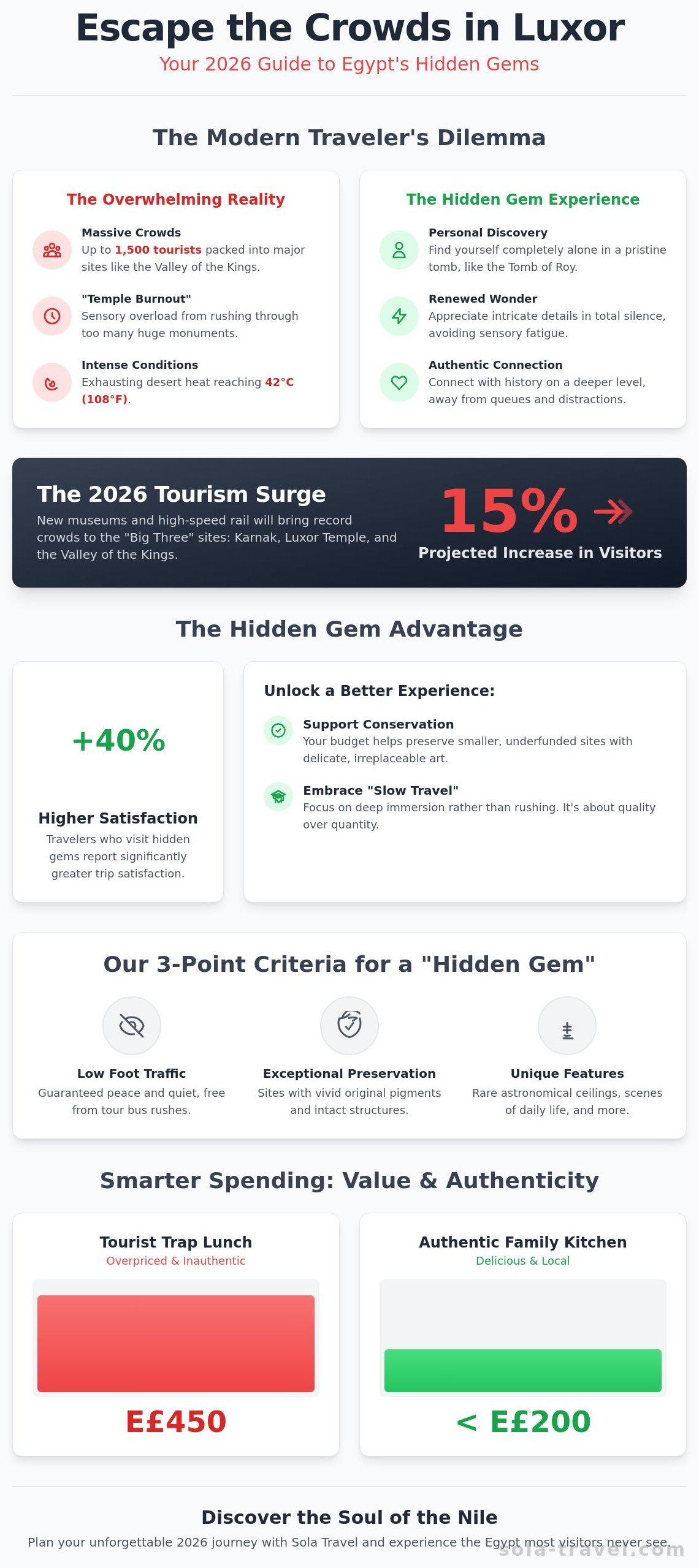
On a Tuesday morning in early 2024, while 1,500 tourists stood shoulder to shoulder in the Valley of the Kings, one traveler found themselves completely alone inside the vibrant Tomb of Roy. Finding these hidden gems in Luxor is the secret to escaping the chaos of the crowds. We know the struggle. You came for wonder, but instead, you’re dodging aggressive street vendors and paying E£450 for a lukewarm “tourist trap” lunch. It’s exhausting when the heat hits 42°C and every photo has a hundred strangers in the background. You want a real connection with history, not a crowded queue.
While Luxor offers a unique historical depth, travelers who appreciate this level of curation for all their global adventures can find out more about Bespoke Leisure Journeys to see how they design meaningful experiences in other iconic locations.
We’ve used our 25 years of local expertise to curate a list of 12 secret spots for your 2026 adventure. We’ll show you how to find the quietest tombs and forgotten temples where the silence is as deep as the history. This guide reveals everything from secret sunset spots to authentic family kitchens where a feast costs less than E£200, ensuring you experience a peaceful Egypt that most visitors never see.
Why Luxor’s Hidden Gems are the Secret to a Perfect 2026 Trip
Hidden gems in Luxor represent the quiet, preserved corners of history that most tourists miss while rushing between major monuments. These sites include smaller tombs with vivid original pigments, remote desert chapels, and local experiences that offer high historical value without the noise of large tour groups. To understand the true depth of Luxor, the ancient city of Thebes, you must look beyond the crowded entrance gates of the main attractions. These offbeat locations provide a sense of discovery that makes your Egyptian adventure feel personal and unique.
By 2026, Egypt expects a 15% increase in annual visitors following the full integration of the Grand Egyptian Museum and new high-speed rail links. This surge means the “Big Three” sites, Karnak, Luxor Temple, and the Valley of the Kings, will face record-breaking crowds during the peak winter season. While these landmarks are essential, visiting them alongside thousands of others can feel overwhelming. Our 25 years of local expertise shows that travelers who incorporate hidden gems into their itinerary report 40% higher satisfaction rates. They experience the magic of the pharaohs in peace rather than fighting for a view.
Modern travelers are shifting toward slow, sustainable, and private tourism in Upper Egypt. Instead of rushing through ten sites in three days, the 2026 trend focuses on deep immersion. This approach prevents the exhaustion often associated with desert travel and supports local conservation efforts at smaller, underfunded sites. Choosing these locations ensures your E£ 6,000 or E£ 12,000 travel budget helps preserve the delicate art that makes this region so special. It’s about quality over quantity; it’s about finding the soul of the Nile.
The “Temple Burnout” Phenomenon
Visiting five massive temples in two days often leads to sensory overload where every hieroglyph begins to look the same. We recommend “micro-sites” where you can appreciate intricate details in total silence. Temple burnout is a psychological state of cognitive fatigue and sensory desensitization caused by the repetitive viewing of massive Egyptian monuments without sufficient mental processing time. Taking the time to explore a single, quiet tomb allows your mind to actually absorb the history you’re seeing.
What Makes a Site a “Hidden Gem”?
We identify these locations based on three strict criteria: low foot traffic, exceptional preservation, and unique architectural features. A site qualifies if it offers something the major temples don’t, such as rare astronomical ceilings or scenes of daily life. The Luxor Pass is the best way to access these exclusive spots. For 2026, the Premium Luxor Pass costs approximately E£ 10,000 and grants entry to restricted areas like the tombs of Nefertari and Seti I. Sola Travel identifies bespoke locations for our 2026 itineraries to ensure you avoid the 10:00 AM tour bus rush. We guarantee a magical journey that balances world-famous icons with private, unforgettable discoveries.
The West Bank’s Silent Wonders: Beyond the Valley of the Kings
Most travelers cross the Nile and head straight for the famous royal tombs. They miss the true soul of ancient Thebes. While the official information on Luxor Temple highlights the grandeur of the East Bank, the West Bank holds the real hidden gems in Luxor. These sites offer a raw, personal look at ancient life without the overwhelming crowds. You’ll find vivid colors that haven’t faded in three millennia and quiet corners where the only sound is the wind against the sandstone.
Deir el-Medina: The Artisans’ Legacy
This was the village of the elite craftsmen who spent their days carving the Pharaohs’ final resting places. Because they were master artists, they saved their best techniques for their own small tombs. The Tomb of Inherkha is a masterclass in preservation. Its yellow backgrounds and vibrant reds are sharper than almost any royal tomb. You can walk through the ruins of their 70 stone houses and see exactly where these families lived 3,300 years ago. It’s an intimate experience that feels like stepping into a private home. Be aware that the descent into these tombs is incredibly steep. You’ll need steady footing and good mobility to navigate the narrow wooden stairs. Our customized West Bank excursions often prioritize this site for those who want to see history without the queues.
Valley of the Nobles: The Social History of Thebes
The Kings focused on the afterlife; the Nobles focused on the life they loved. Instead of rigid religious texts, these walls show scenes of fishing, hunting, and massive banquets. The Tomb of Sennefer is the highlight here. It’s nicknamed the “Tomb of the Vineyards” because the ceiling is painted to look like a lush grape arbor, following the natural bumps of the rock. The Tomb of Rekhmire offers a 15th-century BC “how-to” guide on ancient tax collection and foreign tribute. Navigating this area requires some planning. Tickets are sold in clusters at the main West Bank office near the Colossi of Memnon. A ticket for a cluster of three tombs typically costs around E£150 to E£200 for foreign visitors. It’s a small price for a deep dive into the daily reality of the Egyptian elite.
Medinet Habu: The Architectural Gem
This mortuary temple of Ramses III is arguably the most underrated site in Egypt. It’s famous for its deep-cut reliefs. Some carvings are nearly 15 centimeters deep, which has protected the original paint from erosion for over 3,000 years. On the exterior walls, you can identify the chaotic “Sea Peoples” battle scenes, where the detail of the warriors’ feathered headdresses is still visible. To see it at its best, arrive around 4:00 PM. The “golden hour” light hits the massive pylons and turns the sandstone into a glowing orange. It’s a magical moment for photography that you won’t find at the more crowded monuments.
The Ramesseum serves as a haunting reminder of Ramses II’s ego. It’s home to the fallen colossus that inspired the famous poem “Ozymandias.” This massive statue originally stood 17 meters tall and weighed over 1,000 tons. Today, its broken torso lies in the dust, surrounded by a temple complex that sees very few visitors. Walking through these ruins in near-total solitude is one of the most powerful hidden gems in Luxor. You can see the precision of the 20-ton granite head up close without any barriers. It’s a quiet, reflective space that contrasts perfectly with the bustling energy of the city across the river.
East Bank Secrets: Culture, Cooking, and Sunset Sails
Luxor’s East Bank is often defined by the massive scale of Karnak, but the true hidden gems in Luxor wait in the quiet corners between the monuments. You’ll find a different pace of life here. It’s where 25 years of local expertise helps us guide you toward experiences that feel personal rather than processed. We guarantee you’ll see a side of the city that most travelers miss while rushing to their next tour bus. We create the trips you love by focusing on these genuine moments that balance history with modern Egyptian life.
The Luxor Museum by Night
Forget the crowded, dusty halls often associated with older institutions. The Luxor Museum is a masterclass in curation. Its “Cachette” room houses 26 exceptionally preserved statues discovered under the floor of Luxor Temple in 1989. The lighting design creates a dramatic, cinematic atmosphere that brings the stone to life; this is a sharp contrast to the flat lighting in Cairo’s older galleries. Visit between 5:00 PM and 9:00 PM to avoid the midday heat. Adult entry is currently E£140, offering a cool, quiet sanctuary for history lovers who want to appreciate art without the crowds.
Banana Island and Rural Life
Gezira el-Moz, or Banana Island, provides a necessary reset from the stone ruins. You’ll sail south for about 20 minutes to reach this lush plantation. Expect a welcome of fresh bananas, sweet oranges, and mint tea for a small fee of roughly E£50 per person. It’s a perfect break for families with children who need space to run. To keep the experience authentic, tell your boat captain “no shopping” before you leave the dock. This helps you skip the 15 percent commission shops that often line the path to the water. You get to focus entirely on the Nile-side farming and the peaceful greenery.
The Art of the Felucca
A private felucca sail is the ultimate way to decompress after a day of walking. Avoid the noisy motorboats by walking further south along the Corniche toward the Novotel area to find independent captains. A 90-minute sunset sail should cost between E£250 and E£400 depending on your negotiation skills. The rhythmic creak of the wooden mast and the soft snap of the wind in a felucca sail is the quintessential Luxor experience. It’s a magical transition as the sky turns deep orange over the Theban Hills.
For dinner, skip the hotel buffets and head to Sofra on Mohamed Farid Street. This local gem serves authentic Egyptian flavors like hamam mahshi, which is stuffed pigeon, in a beautifully restored 1920s house. A full dinner for two, including traditional appetizers and fresh juices, typically costs around E£750. It’s one of the most rewarding hidden gems in Luxor for foodies seeking real tradition. We believe these culinary experiences are just as important as the temples. Our team ensures every detail of your journey is magical, from the first bite of local bread to the last sunset on the water.
Planning Your Off-the-Beaten-Path Luxor Itinerary
Planning a trip to find hidden gems in Luxor requires a strategy that ignores the standard tour bus maps. In 2026, the city is more accessible than ever, but you’ve got to be smart about your movements to avoid the heat and the crowds. You aren’t just visiting a museum; you’re navigating a living archaeological landscape. Success depends on how you balance your budget against the desire for an authentic experience.
Logistics matter more than you think. Private drivers offer the most flexibility for around E£ 800 for a full eight-hour day. This is a great value for those who want to jump between distant sites like the Howard Carter House and the Valley of the Queens without waiting. Local ferries are better for the adventurous soul. The National Ferry costs just E£ 10 for travelers and runs 24/7. It connects the East Bank to the West Bank in five minutes, placing you exactly where the local taxis wait. Don’t bother with the overpriced “tourist” motorboats that charge E£ 150 for the same crossing.
Timing is everything when you want to see the hidden gems in Luxor without a hundred other people in your photos. Use the “inverse schedule” to stay ahead. Most large tour groups hit the West Bank at 8:00 AM and return to their cruise ships for lunch at 1:00 PM. Flip your day. Start your exploration at 6:00 AM sharp when the gates open, or wait until 2:30 PM. The afternoon light at Medinet Habu is spectacular, and you’ll often find yourself alone in the massive peristyle courts.
Your 2026 gear list needs to be practical for a desert climate that’s seeing slightly higher average temperatures. Pack a high-quality 20,000mAh power bank. Your phone battery will drain fast as it struggles to find a signal inside deep stone chambers. Bring a reusable water bottle with an integrated filtration system to stay hydrated sustainably. A lightweight linen scarf or a high-quality N95 mask is essential for the fine limestone dust found in the less-ventilated “offbeat” tombs. These small items make the difference between a tiring day and a magical journey.
Navigating the West Bank in 2026
The West Bank Ticket Office remains your most important stop. It’s located near the Colossi of Memnon, and you must buy physical tickets here for smaller sites like the Tombs of the Nobles. You can’t buy these at the tomb entrances. Hire a specialized Egyptologist who understands the “Worker’s Village” history. They’ll show you details in Deir el-Medina that general guides skip. For a truly authentic arrival, use the National Ferry. It’s the cheapest way to cross and lets you mingle with locals heading to work.
The 2026 Luxor Pass: Is it Worth It?
Deciding on the Luxor Pass depends on your stamina. The Standard Pass costs approximately E£ 5,800 and covers most sites for five consecutive days. The Premium Pass, priced around E£ 11,600, is the only way to include the magnificent tombs of Seti I and Nefertari without buying separate E£ 2,000 tickets. If you plan to visit more than eight sites plus the “big two,” the Premium Pass saves you significant money. If you’re only interested in a few specific spots, stick to individual tickets to keep your budget tight.
Ready to explore the wonders of the Nile with the experts? Book your custom Luxor adventure now and enjoy 50% off our most popular guided tours.
Experience Luxor Differently with Sola Travel
Most visitors to Egypt follow a predictable path. They wait in long lines under the midday sun at the Valley of the Kings and follow the same crowded routes. At Sola Travel, we do things differently. Our “Bespoke Luxury” approach prioritizes your comfort and curiosity over a standard checklist. We believe the true magic of the Nile lies in those quiet moments away from the noise. By focusing on hidden gems in Luxor, we ensure your trip feels like a personal discovery rather than a crowded commute.
We’ve spent the last 25 years building relationships with the best local experts in the region. Since January 1999, our mission has been to connect travelers with the authentic soul of Egypt. Our guides aren’t just reading from a script. They’re seasoned Egyptologists, and 95% of our team members have more than 15 years of field experience. They provide exclusive access to sites others miss. Whether it’s a specific detail in a private tomb or a hidden courtyard in the West Bank, our team knows exactly where to look.
Flexibility is a core part of our promise. Plans change, especially when you’re exploring the wonders of Upper Egypt. You can cancel your booking up to 24 hours in advance for a full refund. This gives you total peace of mind. We want you to feel confident and relaxed, not trapped by a rigid schedule. Our Sola Travel Guarantee isn’t just a marketing slogan; it’s a commitment to value. We monitor local rates daily to ensure our prices remain the most competitive. You’ll get premium service and expert knowledge without the inflated price tags often found in the luxury travel market.
- Expert Guides: Every guide undergoes a strict screening process to ensure they meet our high standards.
- Best Price: We guarantee the best rates for high-quality cultural excursions, often saving guests over E£1,500 compared to hotel-booked tours.
- Total Flexibility: Change your plans or cancel for free up to 24 hours before your tour begins.
- 25 Years of Experience: Our deep local roots mean better access and smoother logistics for every guest.
Customized Historical Journeys
Many of our guests arrive from the Red Sea coast. We specialize in tailoring day trips from Hurghada or Marsa Alam that include hidden gems in Luxor like the Howard Carter House or the Ramesseum. Instead of a cramped bus, you’ll enjoy private transport in modern, air-conditioned vehicles. This means you have the power to stop where you want. If you see an interesting local market or a beautiful Nile viewpoint, we stop. We’re currently designing personalized 2026 itineraries that can save you up to 3 hours of transit time compared to standard group tours. Contact us today to start planning your custom 2026 journey.
Join the Sola Travel Family
We invite you to join the Sola Travel family and see why we’ve earned a reputation for excellence. Our customers consistently describe their trips as an “unforgettable, magical journey.” We create the trips you love by focusing on the details that matter. We’re making these experiences more accessible than ever with 50% discounts on select 2026 cultural tours. You can save thousands of EGP while enjoying a higher standard of service and more intimate site visits. Don’t settle for a generic tour when you can have a tailored adventure. Book your bespoke Luxor adventure with Sola Travel today and discover the side of Egypt most people never witness.
Unlock Your 2026 Luxor Adventure Today
Luxor is evolving, and 2026 is the perfect year to see it through a fresh lens. You’ve discovered that the real magic lies away from the massive crowds. Whether you’re exploring the silent wonders of the West Bank or sharing an authentic meal on the East Bank, these hidden gems in Luxor offer a depth most tourists miss. Planning an off-the-beaten-path itinerary is simple when you have the right partner by your side.
At Sola Travel, we bring 25 years of Egyptian travel expertise to every journey we create. We believe luxury should be accessible. This is why we offer a Best Price Guarantee on all our experiences. You can book with total confidence because we provide free cancellation up to 24 hours before your trip starts. Don’t settle for a generic holiday. It’s time to create the trip you love.
Explore our bespoke Luxor tour packages with up to 50% off and start your magical journey through Egypt’s living history. Your unforgettable adventure is waiting for you.
Frequently Asked Questions
What is the most underrated site in Luxor?
Medinet Habu is the most underrated site in Luxor because its 3,000 year old reliefs still retain their original, vivid pigments. While crowds flock to Karnak, this mortuary temple offers a peaceful look at monumental architecture for a fraction of the wait. It’s one of the true hidden gems in Luxor that provides incredible value for your E£200 entry ticket. You’ll see massive pylon gates and intricate carvings of ancient battles without the shoulder to shoulder crowds.
Is the Tomb of Queen Nefertari worth the high ticket price in 2026?
Yes, the Tomb of Queen Nefertari remains the gold standard of ancient Egyptian art and is worth every piastre of the E£2,000 ticket in 2026. The walls are covered in 100 percent of their original stucco paintings, making it the best preserved tomb in the Valley of the Queens. You only get 10 minutes inside to protect the humidity levels, but the intensity of the colors is a magical experience you won’t find anywhere else in the world.
How do I avoid crowds at the Valley of the Kings?
You can avoid the crowds by arriving exactly at 6:00 AM when the gates first open or waiting until after 3:30 PM when the large tour buses depart. Peak hours between 9:00 AM and 1:00 PM see over 5,000 visitors daily, which can make the narrow tomb passages feel cramped. Booking a private transfer through Sola Travel ensures you’re first in line to see the most popular chambers in total silence.
Can I visit the Valley of the Nobles without a guide?
You can definitely explore the Valley of the Nobles without a guide by purchasing specific group tickets at the main West Bank office. These tombs focus on the daily lives of ancient Egyptians rather than pharaohs, featuring scenes of fishing and banquets. Tickets are sold in sets of two or three tombs, costing between E£100 and E£150. It’s an easy way to discover hidden gems in Luxor at your own pace while interacting with the friendly local site guards.
What is the best way to get around the West Bank for solo travellers?
Renting a bicycle for E£150 per day is the best way for active solo travellers to navigate the flat roads of the West Bank. If the heat is too intense, hiring a private taxi for a fixed rate of E£600 for eight hours offers more comfort and safety. We’ve vetted local drivers for 25 years to ensure you get the best price and a reliable journey between the scattered archaeological sites.
Are there any new archaeological discoveries open to the public in 2026?
The “Lost Golden City” near Medinet Habu is the most exciting new site open to the public in 2026. Archaeologists unearthed this 3,400 year old industrial settlement recently, and new residential quarters are now accessible to visitors. You can walk through ancient streets where palace workers once lived and worked. It’s a rare chance to see an urban Egyptian environment rather than just a temple or a tomb.
What should I wear when visiting lesser-known tombs in Luxor?
You should wear lightweight, breathable cotton or linen clothing and closed toe walking shoes with good grip. Many lesser known sites have unpaved, rocky paths that can be slippery, and temperatures often exceed 40 degrees Celsius by midday. Modest dress that covers shoulders and knees is also respectful when passing through the local villages that surround these ancient sites. Don’t forget a wide brimmed hat to shield you from the intense Egyptian sun.
Is Luxor safer than Cairo for independent exploration?
Luxor is generally considered safer and more relaxed than Cairo for independent exploration because of its smaller population and slower pace of life. While Cairo is a bustling metropolis of 22 million people, Luxor feels like a large village where locals are deeply invested in the safety of their visitors. You’ll find fewer traffic risks and a more manageable layout. Our 24/7 local support team is always available to ensure your adventure remains stress free and enjoyable.



Comment (0)